Middle Eastern house salad

Tuesday, July 28, 2009

Posted by Antonio Tahhan

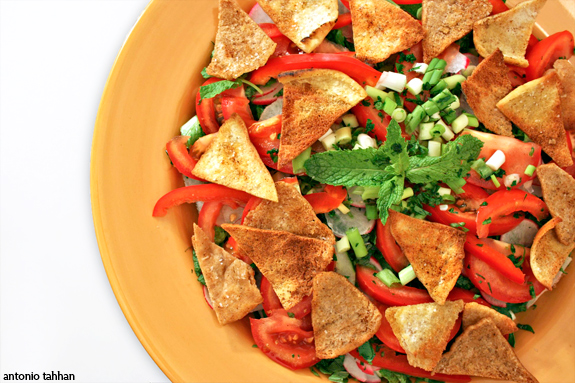
Sorry this is a day late. I was in Seattle for most of last week for the Web Design World conference and then spent time with my parents who came to visit me for the weekend. Seattle was beautiful and I cannot wait to show you pictures, but first, there's a salad I've been meaning to write about - it's called fattoush (فتوش).


It seems like the market for Middle Eastern salads outside of the Middle East is disproportionally dominated by tabbouleh, a salad, that when made right, combines ultra-finely chopped parsley with tiny pearls of fine-ground bulger wheat and other finely chopped vegetables. Fattoush is quite the opposite, at least when it comes to preparation - it can be thrown together in a matter of minutes, in a very rustic and hearty way that's all about flavor rather than embellishments. Tabbouleh is delicious though, don't get me wrong. Sometimes, however, I just want a quick and tasty, no-frill salad, and for moments like these I make fattoush.


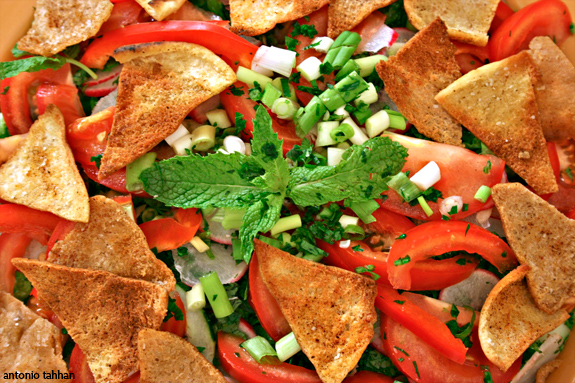
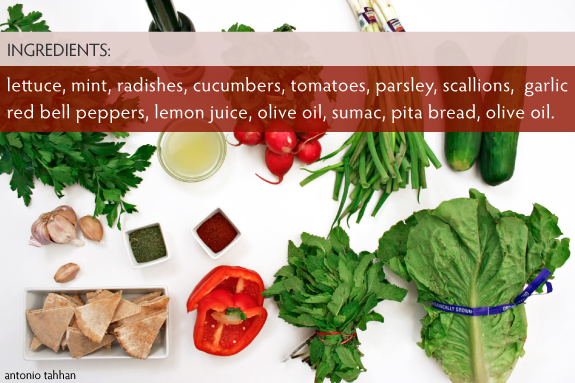
The mise en place can be overwhelming, but in one trip to the farmer's market you can have all these vegetables laid out on your table, too. The most exotic ingredient here is probably the sumac, which is a lemony, sour spice that can be found in most specialty markets these days and certainly any Mediterranean market you know of. If you like cooking Middle Eastern dishes, this is a spice that you should always have on hand.


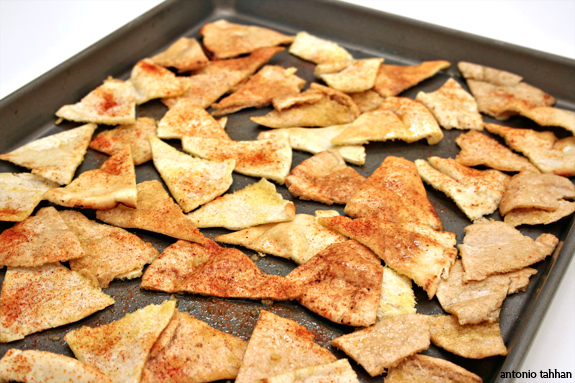
This is the part where some people might disagree: the bread. Probably the best (and most traditional) way you can prepare the bread for fattoush is by pan-frying the triangles in extra virgin olive oil, but that takes a long time and makes a mess of my stovetop. I prefer to toss the triangles in olive oil, sprinkle some sumac on the bread (something my grandmother taught me), and throw the whole tray into the oven/broiler, on high.


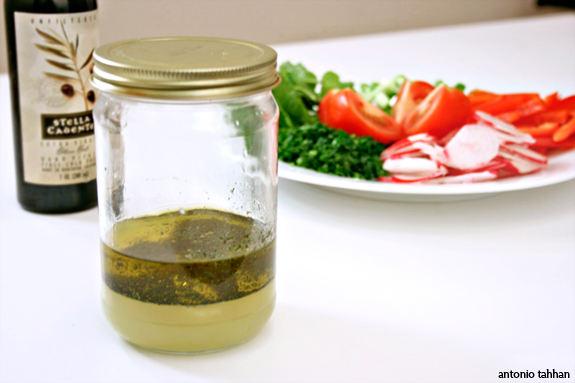
The dressing for this salad is equally simple, as promised. It's a combination of olive oil and lemon juice, with a sprinkle of salt and sumac - that's it. You can add dried mint to the dressing like I did, but that's completely up to you.


Click here to view or print the recipe.


This post was written by Tony


Are you interested in contributing to The Daily Tiffin? Drop us an email: thedailytiffin@gmail.com. We look forward to hearing your ideas.

Vegetarian Pyramid Series - Wheat Berries

Thursday, July 23, 2009

Posted by DK


Have you noticed how certain ingredients which were earlier labeled as “Poor Man’s Food” have now come to be adorning the health food stalls of today? Or sometimes even the gourmet plates of people calling themselves the connoisseur of fine food? Paradox or the fate of homosapiens today? – call it whatever, it sounds indeed heartening that whole “complete” foods have come to be cherished and they have finally “arrived” at last.

What Are Wheat Berries?

Among such ingredients, Wheat berries find its rightful place. They are nothing but Whole Wheat grains with the husks removed. The ones responsible for imparting nutrition to our body – the bran, the germ and the endosperm – remain intact and that’s why consuming these are extremely beneficial. For the least amount of calories, you get maximum amount of fiber and nutrition. I mean with such a bargain – what is it that you are waiting for?

How do they look and where to look for them?

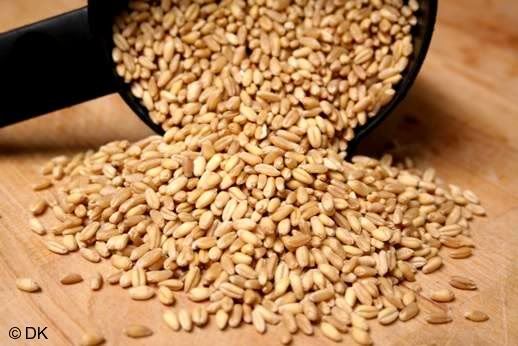
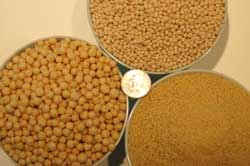
I know when someone mentions a new ingredient to me, my brain cells starts grappling to any image that it could possibly associate to in its memory book and if nothing comes around, gets frustrated. So to avoid this unnecessary process let me show you a picture which will put you at ease and the next time you buy these, you know you are not bringing home something else assuming them to be these berries!


The berries are sturdy grains with brownish-reddish tinges. Here in the U.S they are mostly available in the health food section. In India they can be bought in regular stores which sell grains.

How to cook Wheat Berries?

To do it the propah way, it would have to be:
  • Clean and soak the wheat berries overnight,
  • Cook them on a stove top for 1 to 1-1/2 hours until the grains get chewy and add them to your salads or something of your choice
But the motive of this post is to make sure you consume these grains and not to chase you away with the labor associated with them! I mean the way the current universe is trying to maintain its balance on a roller coaster ride, we don’t have the time to waste – ‘err I mean’ – to embark on such strenuous process.

Hence quick method to cook these is:
  • Buy a Pressure cooker. I know that you know that you can afford it! Awe come-on – imagine the amount of time you save, the extent of nutrition that you are going to gain for the “pounds” [ pun intended ] you are going to lose. And this gadget lasts like forever!!
  • Soak the grain overnight (or forget it! Doesn’t matter).
  • For 1 cup of Wheat Berries add 2 cups water and cook for 15-20 min ( which amounts to approx 5-6 whistles for me in an Indian styled cooker)
For the curious cats - lemme put it in another way - for the Knowledge Thirsty - here is a comprehensive list of ways to cook Wheat Berries, if you are interested, where it includes cooking methods in microwave, stove top, pressure cooker even rice cooker.

Recipes that Make Wheat Berries interesting

Just like there is a myth floating around that vegetarian foods are bland and that they suck ( sorry to burst your bubble, but its that recipe in your hand that does), there is also this hate-hate relationship with foods which are listed under ‘Health Food Section’. Forget your Arborio rice, these Wheat berries when cooked throw up fierce competition in the chewy department. Move over plain old white rice – Wheat berries are here.

They can be enjoyed as
  • Breads (I have one baking in my Oven right now! Yum)
  • Soups ( my recipe below )
  • Stews ( see this recipe and tell me if you are not inspired!)
  • Or come to think of it - throw in some the next time you make your favorite Chicken casserole. No one will know! Even if they do who cares – they will be tasty – so no worries
I have one recipe in my blog to convert you into wheat berry hoarder

Wheat Berry and Pinto Soup is one hearty and yummy appetizer which I assure you will warm its way into your appetite.


I am trying out some pancakes with some wheat berries too! It’s a new whole world out there – Why don’t you take a gander with me to explore these, burp with satisfaction and say bon appétit!

This post was written by Dhivya

Are you interested in contributing to The Daily Tiffin? Drop us an email: thedailytiffin@gmail.com. We look forward to hearing your ideas.

The luxury of homemade Mascarpone...in a cake!

Saturday, July 18, 2009

Posted by Deeba PAB

Have you tried making soft cheese at home?

I've tried & I'm sold on the idea. Not only is it a much cheaper option, it's also a very satisfying process. Fresh cheese should be moist and white, with no sign of mold. The fat content of fresh cheese varies as they can be made from whole or skimmed milk, or even with cream. I've been on a soft cheese making spree these days, having been completely taken in by the luxury of homemade soft cheese, amazed at the freshness & smoothness. It's from Vera's Baking Obsession that I've tried homemade ricotta & mascarpone, both with outstanding results. Cottage cheese is something inherent to Indian culture, & is made in almost every home, ours too. My next attempt is going to be Quark, from a recipe @ Meeta's What's For Lunch Honey. I'm going to share a recipe for a cake I made using homemade mascarpone, a cake I made for my father's birthday. It was a delicious to goodness cake with a genoise sponge as the base. The crumb of the genoise was light, tender & moist, and a dousing of coffee syrup made it perfect! Sandwiched with a cream as luxurious & indulgent as homemade mascarpone, the cake was perfect. Just right - not exceedingly sweet, light, yet luxurious! I made the mascarpone 2 days in advance, the genoise a day in advance, & refrigerated both.

HOMEMADE MASCARPONE CREAM
as adapted from Baking Obsession
Makes about 12 oz
Ingredients:
600ml low fat cream (25 %) pasteurized (not ultra-pasteurized), preferably organic cream
1 tbsp fresh lime juice Method:
Bring 1 inch of water to a boil in a wide skillet. Reduce the heat to medium-low so the water is barely simmering.
Pour the cream into a medium heat-resistant bowl, then place the bowl into the skillet. Heat the cream, stirring often, to 190 F. It will take about 15 minutes of delicate heating.
Add the lime juice and continue heating the mixture, stirring gently, until the cream curdles. Do not expect the same action as you see during ricotta cheese making. All that the whipping cream will do is become thicker, like a well-done crème anglaise. It will cover a back of your wooden spoon thickly. You will see just a few clear whey streaks when you stir.
Remove the bowl from the water and let cool for about 20 minutes. Meanwhile, line a sieve with four layers of dampened cheesecloth and set it over a bowl. Transfer the mixture into the lined sieve. Do not squeeze the cheese in the cheesecloth or press on its surface (be patient, it will firm up after refrigeration time). Once cooled completely, cover with plastic wrap and refrigerate (in the sieve) overnight or up to 24 hours. CHOCOLATE GENOISE
As adapted from this recipe @ Baking Obsession
Ingredients:
3 tbsp clarified butter/ghee
1 tsp pure vanilla extract
1/3 cup all-purpose flour
1/3 cup unsweetened Dutch-process cocoa powder
4 large eggs (I used 5 as the eggs were smallish)
2/3 cup fine granulated vanilla sugar
Method:
Preheat the oven to 350F. Line, grease & flour an 8-inch round cake pan.
Sift the flour and cocoa together three times; reserve.
Bring some water to a boil in a large pan/griddle & reduce to simmer. Place eggs & sugar in a large bowl, whisk constantly over the simmering water, heat the eggs to lukewarm (about 105F). Remove the bowl from the pan; leave the skillet on the stove but turn off the heat. With an electric mixer, beat the egg mixture at high speed until it has cooled, tripled in volume, and resembles softly whipped cream, about 5 minutes in a heavy-duty mixer or longer with a less powerful mixer.
Meanwhile, set the bowl of clarified butter/ghee and vanilla in the skillet of hot water, with the burner off, to keep it warm.
Sift about one-third of the flour and cocoa over the whipped eggs. Use a rubber spatula to fold in the mixture-quickly but gently-until combined. Fold in half the remaining flour and cocoa, then fold in the rest. Remove the warm butter mixture from the skillet. Scoop about 1 cup of the batter into the bowl with the butter and fold together until completely combined. Use the large rubber spatula to fold the butter mixture completely into the remaining batter. Turn the batter into the prepared pan and tilt to level.
Bake until the cake beginning to shrink slightly around the edges and the top springs back when pressed with your finger, about 40-45 minutes. Cool the cake completely in the pan on a rack.
To unmold, run a small knife or spatula around the inner edges of the pan. Invert it onto a rack and remove the parchment liner. Turn the cake right side up. The génoise can be wrapped and refrigerated for up to 2 days, or frozen for up to 3 months.
MOCHA MASCARPONE FROSTING
Ingredients:
12oz Mascarpone Cream (recipe above)
200ml low fat cream (25% fat)
1 tsp coffee powder (increase or omit as desired)
2-3 tbsps ground vanilla sugar, or regular sugar (according to taste)
Method:
Beat mascarpone cheese with a wooden spoon till smooth. Fold in the rest of the ingredients & mix with the spoon till smooth. CHOCOLATE GENOISE CAKE with MOCHA MASCARPONE
Ingredients:
1 chocolate genoise sponge (recipe above)
1 portion of Mocha Mascarpone Cream (recipe above)
Coffee syrup
Dark chocolate shavings, flakes & coffee beans etc to garnishTo assemble:
Make a strong coffee syrup with 1/4 cup of hot water, 2-3 tsps sugar & 2 tsps coffee powder. Cool.
Cut the genoise into 2 horizontal layers.
Place one layer on the cake platter. Brush well with the coffee syrup. Sandwich with a little less than half the mocha mascarpone.
Top with the second layer, & brush that well with the coffee syrup.
Frost the top & sides of the cake with the remaining mascarpone. Grate dark chocolate over the top, edge with coffee beans, & sift cocoa over the edges.
Chill for 3-4 hours.


This post was Written by Deeba

Are you interested in contributing to The Daily Tiffin? Drop us an email: thedailytiffin@gmail.com. We look forward to hearing your ideas
Edible Flowers

Thursday, July 09, 2009

Posted by Andrea Meyers

Andrea's Recipes - Johnny Jump Ups (violas)

Flowers have long been used in cuisines around the world, including ancient Rome, Greece, and China, and the practice is once again growing in popularity. Growing your own edible flowers will add beautiful color to the landscape as well as delicious flavors to your table, and you can control the conditions and safety of your edible flowers by following organic cultivation practices.

Precautions

Not all common flowers are edible, and even some edible flowers can cause discomfort if consumed in large quantities. Daylilies can act as a diuretic or a laxative, and apple blossoms have cyanide precursors, so always research the type of flower you plan to use before adding it to food.

Pesticides for flowers have not been tested to determine safety on food crops, so be very careful and make sure the flowers have not been sprayed with pesticides or other chemicals. For this reason you should avoid flowers from florists, nurseries, garden centers, and any growing by the roadside. Exercise caution if you have allergies, asthma, or hay fever as some flowers may cause a reaction.

The following is a brief list of common edible flowers in North America, but this list is not exhaustive. For more detailed information, you may want to consult an authoritative book on edible flowers or contact your state’s university cooperative extension. You can find a list of poisonous flowers at Wikipedia.

Herb Flowers

basil
chives
dill
lavender
mint
rosemary
sage
thyme

Ornamental Flowers

calendula
carnations
chamomile
chrysanthemum
daylilies
impatiens
Johnny-jump-up
nasturtiums
pansies
scented geraniums
tulips
violets

Andrea's Recipes - Tulips

Trees & Shrubs

apple
fig
hibiscus
lilacs
peach
pear
plum
roses

Vegetables

arugula
broccoli
fennel
okra
squash

References

North Carolina State University, Department of Horticulture – Edible Flowers

Iowa State University Extension – Reiman Gardens: Edible Flowers

National Gardening Association – Edible Landscaping: Growing Edible Flowers in Your Garden

Wikipedia – Edible flowers

Wikipedia – Poisonous flowers


This post was written by Andrea

Are you interested in contributing to The Daily Tiffin? Drop us an email: thedailytiffin@gmail.com. We look forward to hearing your ideas.

Blender Carrot Cake

Sunday, July 05, 2009

Posted by Anonymous

This is one of my favorite cakes, it can be made in almost no time at all, and is perfect to go into lunchboxes, as you can cut it into any shape desired (aka the leftover space in the bento).


The recipe was given to me by a friend who received it from her guest mother in Brazil, and it has become a family favorite ever since. In Brazil it is called bolo de cenoura.

You can prepare the batter in a blender or in a food processor.

Ingredients:

  • 2 large carrots
  • 150 ml vegetable oil
  • 240 g sugar
  • 2 eggs
  • a pinch of salt
  • 240 g flour
  • 1 tablespoon baking powder

Combine carrots, eggs, oil, sugar and salt in a blender or food processor and pulse until smooth. Add the (sifted) flour and baking powder, process until a batter forms. Pour into a baking dish (I used my new IKEA reactangular baking pan, which was perfect) and bake in a medium hot oven until done (test with a toothpick).


Of course you could add any frosting you like with carrot cake, but we prefer this plain.


This post was written by Petra from Foodfreak


Are you interested in contributing to The Daily Tiffin? Drop us an email: thedailytiffin@gmail.com. We look forward to hearing your ideas.

WHAT'S ALL THE TWITTER ABOUT?

Friday, July 03, 2009

Posted by Deeba PAB

Twittering changed a part of my life, for the better. About an year ago, I read about an article about Twitter & how this micro blogging application is changing the world. At the time, I understood it minimally, but it held my attention. Eventually, I began twittering, after being coerced into it by my bunch of foodie friends, and it changed a part of my life. I find that twittering brings people closer, bridges gaps and helps build long lasting relationships. Being part of this forum, allows you to think about issues differently, sometimes 'out of the box'. More people mean more perspectives, in harmonious balance, because you choose who to follow! Do you Twitter? Has it changed your life?

What's Twitter all about?
By accepting messages from sms, web, mobile web, instant message, or from third party API projects, Twitter makes it easy for folks to stay connected. Simplicity has played an important role in Twitter's success. People are eager to connect with other people and Twitter makes that simple. Twitter asks one question, "What are you doing?" Answers must be under 140 characters in length and can be sent via mobile texting, instant message, or the web.
What I like about Twitter ...
  • Always someone to tweet to at any given time night or day
  • Can catch up with friends in uno momento
  • Can join like minded groups - foodie, medical, parenting etc, & find passionate people
  • Make new friends who are a treasure & absolute fun
  • Meet up with bloggers that you might not be able to keep up with otherwise
  • ALWAYS someone who says good morning or good night to you with a HUGE smile!
  • 'Tweeples' are the most fun & helpful people. Just a tweet with a question or dilemma & rest assured, there's bound be a solution soon, if not many
  • Photo uploads to share take a couple of seconds
  • News breaks fastest here. Is Twitter the Face of 21st Century News? ... but sometimes the reliability is in question
  • It's easy to lend support to a political/social movement. Currently quite a few of us are 'draped in green' to lend support to the situation in Iran

Twitter is addictive & gobbles away a large part of your day if you aren't careful. Sometimes I need to be peeled away from twitter. It's fun, not eactly or easily describable, but a whole lot of FUN!

To get twittering, all you need to do is get an account on Twitter, & then get a desktop application/tool to make life easier. Some tools are TweetDeck , Twhirl, Twitter Gadget, Twitterrific, Twitterfeed and TwitThis. Check out lots more applications here, & get twittering!!

This post was written by Deeba

Are you interested in contributing to The Daily Tiffin? Drop us an email: thedailytiffin@gmail.com. We look forward to hearing your ideas.

Gulkand

Tuesday, June 30, 2009

Posted by Indian Food Rocks

It's no secret that I am a lazy gardener. I prefer to let wildflowers and native grasses rule my yard than spend hours tending to specialty flowers and plants. The few plants that I have brought into my yard are drought-resistant. My neighbor cultivates roses. He has blossoms of various colors on the same bush. Me? I love the wild rose, Rosa woodsii.


It's a treat to see this wild rose in bloom as it lasts for just a day. If I could, I would have a thicket of wild roses to line my property but wilder things would leap over it, so I have abstained from taking it on. I do have a bush of hardy climbing roses that refuses to die. When it didn't bloom one year, I was rather thrilled because I had other plan(t)s for the coveted spot it is in, but it bounced back the following year and blooms profusely late spring through early summer.


If I hadn't been consumed by bed bug bites during late spring last year, I might have noticed my climbing rose bush. This year, I did take notice: the flowers are small but they do have a pleasant fragrance. That, to my mind, translates into essential oils even though this is no damask rose. I figured that these roses might have at least some of the 300 compounds reported to be found in rose oil.

While roses are generally not used in western cuisine, their culinary history can be traced back to Persia. Roses are used as flavoring agents in Middle Eastern as well as Indian cooking. Since I do not have the wherewithal to make rose water or extract rose oil, I decided to do the next best thing: make Gulkand in the sun, now that we have a respite from the incessant rains we have seen this spring. Gulkand is often referred to as rose petal jam but let's please just call it gulkand (Gul-kundh) - gul for rose and kand for sweet.

My first task was to deadhead the bush. Once I had that out of the way, I took stock of the number of buds on the bush to make sure that I would have enough petals to justify making gulkand. Just opened blooms are best for gulkand so it's worth the effort to wake up early to pluck the flowers off the bush.

Remove the petals gently, discarding petals that may be disfigured, have holes or appear to be eaten by insects. Also, discard the rest of the flower. Inspect closely to make sure there are no insects or other creatures that might inadvertently make it into your gulkand, making it not so vegetarian.

Wash the petals several times and lay them out on a wad of paper towels. There is no need to pat them dry as any residual water will simply aid in making the sugar syrup.


In an wide-mouthed jar, make layers of rose petals and sugar, pressing down with a spoon every so often and finishing off with a layer of sugar at the very top. Since my flowers were small, I arrived at the following estimate for a recipe:
3-4 cups of rose petals
3/4 to 1 cup of organic sugar
3 cloves (optional)
seeds of 1 cardamom (optional)

I like the hint of spices in my gulkand so I added cloves and cardamom. Allow this to cook in the sun for at least two weeks. Open it up every other day, not just to get a whiff of the heady fragrance, but to mix it up, too.


This little jar was overflowing when I put the lid on it. It whittled down to just about an inch thick in less than a day. I made two more jars of the same quantity and after a week of being in the sun, I combined them all into this same jar. It's been just over a week and I will update this post with a picture of gulkand as soon as it is ready. Until then, take a look at Anita's Gulkand.

If you have roses that have not been sprayed - please do not use store-bought roses unless you know they are organic and safe for consumption - do give this a try. It's great as a summer activity for kids, too. Which kid doesn't like ripping petals off flowers? They can also take the responsibility for putting the jar out in the sun and bringing it in every day.

Gulkand is supposed to have cooling properties and is best consumed in summer. And, supposedly a host of other benefits for the entire body. My parents sourced the purest and best gulkand for me to help cool my highly myopic eyes and perhaps even deter what genetics had in store for me. I can't say that it worked but I do know that unlike those awful Threptin biscuits that I launched off an 11th floor balcony or that terrible tasting Chyawanprash that followed a trajectory to the ledge under my bedroom window, gulkand made its way safely to my stomach with the spoon being licked clean each time!


This post was written by Manisha

Are you interested in contributing to The Daily Tiffin? Drop us an email: thedailytiffin@gmail.com. We look forward to hearing your ideas.

A world outside of mozzarella & pepperoni

Sunday, June 28, 2009

Posted by Antonio Tahhan

A simple google search for kid-friendly recipes is scary. What shows up, in fact, is a harrowing slew of butter-saturated, sugar-filled recipes written with a complete disregard for health. I discovered this last week because I was looking for just that - simple recipes that I can make with kids.

My friend Beth invited me to cook in front of a class of kindergarten students. Her son is in the class and they were looking for someone to do a cooking demo for the kids' end of the year party - I was flattered that they thought of me and happily accepted.

I took this as my tiny opportunity to make a difference in the way these kids looked at food. While this was not the time to introduce them to the delicate flavors of perfectly-seared scallops or steak tartare, I wanted to cook with them something they're familiar with, but probably never had before. I decided to let them make their own pizzas. Instead of just mozzarella and pepperoni though, I brought with me a ton of different vegetables and all sorts of sauces for them to experiment with. Well-aware of the fact that the kids will have a short attention span that rivals mine, I also brought with me my pizza paddle and pizza stone so they could take turns sliding their pizzas into the oven.


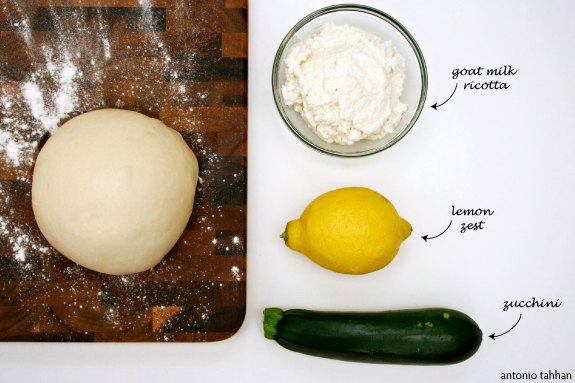
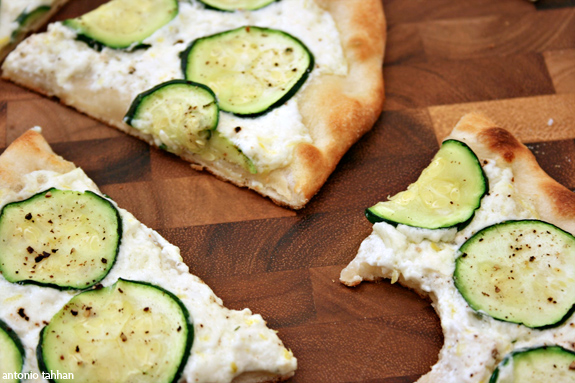
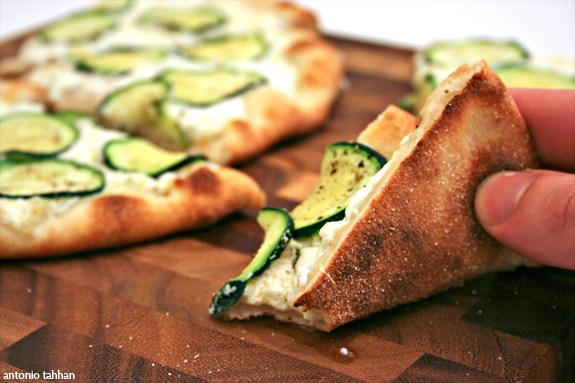
This is my first article for The Daily Tiffin, and it couldn't have come at a better time. Inspired by my pizza event last week and the smoldering heat of the summer, I decided to make a lemon-infused, goat ricotta, white pizza topped with thinly sliced zucchini. The flavors are light, refreshing, clean - perfect for the hot summer days ahead.


Count them - four ingredients; five if you include the extra virgin olive oil. This means no skimping on ingredients! I tried this same pizza with regular ricotta and it doesn't work. The wow factor just wasn't there. If you absolutely cannot find goat-milk ricotta, however, not to worry. Mix a semi-firm chevre (like Spanish Capricho de Cabra) with some good quality, fresh ricotta and you'll get a similar result. Like I said, it won't be spot-on, but you'll get pretty darn close.


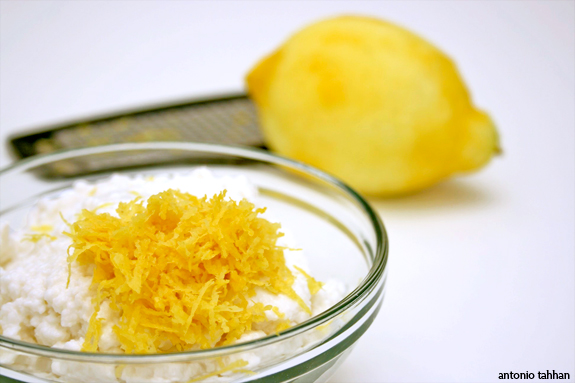
The lemon zest in the ricotta serves two purposes. Not only does it heighten the flavors of the goat cheese, but it also gives the pizza a clean, crisp flavor. If you can get organic lemons, I recommend them because their zest tends to be more flavorful than their non-organic buddies.


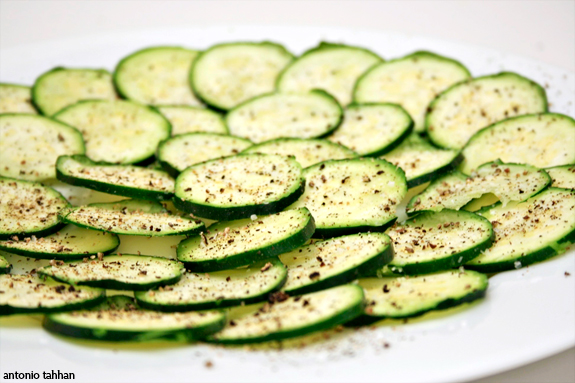
Zucchini in general has lots of moisture and moisture is the kryptonite, so to speak, of pizza. To remove some of this excess moisture you'll want to thinly slice the zucchini (preferably with a mandoline) and fan the slices out on a plate so they're not on top of each other. Then season the slices with salt and pepper and the salt will start to break down the cell walls of the zucchini, and thus allowing it to give up some of that moisture. Soak it up with a paper towel and your ready to roll.


The kids were shocked when I hinted to the idea of a pizza without red sauce. Their facial expressions were absolutely priceless. And although not many ventured down this path, I feel like those that did may have a bright culinary future ahead of them.


Recipe:
Ingredients:


  • 24 oz. pizza dough

  • 2-3 tbsp extra virgin olive oil

  • 1/2 lb goat milk ricotta

  • zest of 1-2 lemons

  • 1 zucchini, thinly sliced

  • salt and pepper, to taste


Putting Them all Together:

  1. Zest the lemon(s) and stir the zest into the goat ricotta

  2. Thinly slice the zucchini (preferably with a mandoline), fan out on a plate, season with salt and pepper, and cover with a paper towel to soak up some of the moisture.

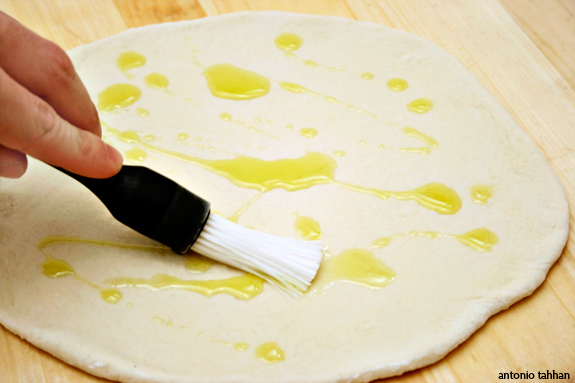
  3. Stretch pizza dough to approx 1/8" thickness - this pizza is better thin than thick - and brush a thin coat of olive oil over the top.

  4. Spread the goat cheese mixture over the top and top with the thin slices of zucchini.

  5. Preferably bake on a hot (550 degrees F) pizza stone for 5-7 minutes or until the crust gets golden brown.


This is why everyone should invest in a pizza stone:


This post was written by Tony


Are you interested in contributing to The Daily Tiffin? Drop us an email: thedailytiffin@gmail.com. We look forward to hearing your ideas.

Happy Father's Day!

Monday, June 22, 2009

Posted by Mansi

Happy Father's Day to all the readers of The Daily Tiffin!

It's one of those holiday weekends in US where it has become a norm to celebrate special "days", mostly to help the economy and gift- stores. However, I was a bit surprised to read the history behind the origin of Father's Day.

According to this source, Mrs. John B. Dodd, of Washington, first proposed the idea of a "father's day" in 1909. Mrs. Dodd wanted a special day to honor her father, William Smart. William Smart, a Civil War veteran, was widowed when his wife (Mrs. Dodd's mother) died in childbirth with their sixth child. Mr. Smart was left to raise the newborn and his other five children by himself on a rural farm in eastern Washington state. It was after Mrs. Dodd became an adult that she realized the strength and selflessness her father had shown in raising his children as a single parent.

This story proves that a father's role is as important as a mother's in the life of a child, and even if Mothers have a higher involvement in their lives, the presence and effect a father's influence can never be ignored or underestimated!

In 1924 President Calvin Coolidge supported the idea of celebrating Father's Day nationally, and in 1966, President Lyndon Johnson signed a presidential proclamation officially declaring the 3rd Sunday of June as Father's Day.

I'm not a great fan of celebrating all the different kinds of "Days" that have become an excuse for unwarranted gift-giving. But I do agree that some of these have a genuine message or purpose; they make you sit back and appreciate the significance of an event or a person in your life. However, it does NOT mean that you can ignore that person for the remainder of the year, or express Fake love or caring just on that one day, it does provide you an opportunity to plan something ahead and do something special, just because its hard to find time for things like these in normal day-to-day lives.

Whether you believe in this concept or not, is totally your choice. But I feel celebrating Mother's Day and Father's Day is a nice way to inculcate love and respect for a parent in a young child's mind. Just involve your kids in doing something together as a family, and they'll appreciate the fact that he is lucky to have a mom and dad who care for each other; it makes the kids feel more loved and secure, and will eventually help them be more empathic and emotional toward other relationships.

I would like to cite here President Obama's Father's Day Letter to the fathers of the world. In his own words, he says: In many ways, I came to understand the importance of fatherhood through its absence," says Obama, who was 2 when his father left. "I came to understand that the hole a man leaves when he abandons his responsibility to his children is one that no government can fill."

So, here's wishing a Very Happy Father's Day to all the dads in this world from the DT team, because all of you are doing a tremendous job out there, taking care of your kids and families. And though your children may not always tell you this, be sure to believe that you are very important to them, and NO ONE but you, can ever take your place!


This post was written by Mansi

Are you interested in contributing to The Daily Tiffin? Drop us an email: thedailytiffin@gmail.com. We look forward to hearing your ideas.

Vegetarian Pyramid Series - Couscous

Monday, June 15, 2009

Posted by DK

“Eating Balanced Meal is everything” - How many times have we heard this? But for a full time working woman, making a meal 3 times a day is big deal by itself – leave alone making it ‘Balanced’!! So does that mean we get slack about eating a healthy meal – of course not. What we can do is to make sure that we incorporate ingredients in such a way that not only they are fast to make, but also easy, delicious and nutritious too! “Awe come on, you got to be Kidding me!” I hear ya, but it’s true that indeed you can.

The vegetarian Pyramid Series that’s been going on for past few months is going to showcase one such ingredient today – Couscous! When the hard wheat is ground, it leaves few granules which resisted grounding which is what we call semolina. This is actually the endosperm of wheat which has proteins, mineral salt and also floury mass which is what constitutes the making of Pasta.

Although the term ‘couscous’ also refers to a cooking method, I am just going to focus on Couscous instead.Although the original couscous (called as Rolling Couscous) takes longer and requires more prep work to cook, nowadays the ones available are pre-steamed and hence reduces the cooking time drastically.


Image source : acornadvisors.com

From my research, I have come to believe that there 3 main types of couscous available.

Moroccan couscous:

This is probably what you would find most often in your shop aisles. These are commonly available and are tiny yellow semolina pasta. All you have to do is to boil sufficient amount of water, turn off the flame, add the couscous and let it sit for 10 minutes with the lid on. The couscous is done when all the water is absorbed and all you have to do is to fluff it with a fork and serve! Wasn’t that easy? Innumerable have been the times when I have just boiled some vegetable stock, added few frozen vegetables along with couscous – a little bit of seasoning and tada! Lunch/Dinner is ready.

Check out a yummy Moroccan Tagine with Couscous


I also find a Whole Wheat couscous variety which is lightly brown in color and cooks the same way as the regular yellow couscous. There is not much of a difference in taste.

Israeli Couscous:

This variety takes a little longer to cook than the Moroccan variety, but I have come to like it way lot than the former. It has more chewy texture to it which I love. These are larger than the Moroccan type, beige white in color, about the size of peppercorns


Colorful, filling and delicious Israeli Couscous Recipe


Lebanese couscous:

This is the largest of all couscous types. I have personally not been able to get my hands on them, but they are supposedly the size of small peas. The cooking process, naturally, is longer then the usual couscous and is more suited for cooking like the way you would do for Risotto.

Note: Make sure whether you have bought the traditional or instant type of Couscous. The traditional couscous takes a longer cooking time, where it is originally steamed in a specialized steamer called as “couscoussiére.”

Health Benefits: It is immensely low in fat and is enhanced with complex carbs. It is rich in dietary fiber, protein, potassium etc

This post was written by Dhivya


Are you interested in contributing to The Daily Tiffin? Drop us an email: thedailytiffin@gmail.com. We look forward to hearing your ideas.

Summer Fruits: Blueberries

Thursday, June 04, 2009

Posted by Andrea Meyers

Andrea's Recipes - Blueberries

Summer wouldn’t be the same without some of our favorite fruits, and blueberries are at the top of the list. Though native to northeastern parts of North America, they are now grown in many parts of North America and in other countries around the world. Blueberries typically fall into two categories: highbush, which can grow as much as 4 meters tall; and lowbush (aka “wild”), which typically grow just 35 centimeters tall or less, but can grow as tall as 60 centimeters. The various species produce fruit at different times in the season, and are thus categorized as early, mid-season, or late.

Early fruits start arriving in the United States in mid-May, so blueberries are already in the markets and grocery stores. We planted six blueberry bushes this spring with harvest times spread all across the season in hopes of having blueberries throughout the summer. It takes a few years before the bushes produce fruit and you have to protect them from birds and other animals, which enjoy the berries as much as people do. The fruits can be used in a wide variety of ways, including preserves, baked goods, frozen desserts, sauces, yogurt, beverages, or just enjoyed out of hand.

In recent years blueberries have received recognition as an important food for good nutrition. Both lowbush and highbush blueberries are rich in vitamins and cancer-fighting antioxidants, and studies conducted by the USDA Human Nutrition Research Center have shown benefits in the fight against chronic disease and reversal of short-term memory loss associated with Alzheimer's as well as the loss of motors skills with age. Recent studies even demonstrate a link between blueberry consumption and improved blood pressure, lowered cholesterol, and total lipid levels.

So go ahead, treat yourself to the the taste and health benefits of blueberries while they are in season, and if it’s hot where you are you can try this berry sorbet made with blueberries, raspberries, and marionberries.

THREE BERRY SORBET

Sorbet_three_berry4

Makes about 1 quart.

Equipment

medium saucepan
blender
fine mesh strainer
1 to 2 quart bowl with lid (or plastic wrap)
ice cream freezer

Ingredients

1 cup (175 g) granulated sugar
1/2 cup (120 ml) water
1/2 teaspoon salt
1 pound (~900 g) blueberries, rinsed and patted dry
8 ounces (~450 g) raspberries, rinsed and patted dry
8 ounces (~450 g) marionberries (or other blackberries), rinsed and patted dry
1/4 cup (60 ml) freshly squeezed lemon juice

Preparation

1. In the saucepan combine the sugar, water, and salt. Cook over medium heat until completely dissolved. Let cool for 15 minutes.

2. In the blender, purée the berries with the syrup and lemon juice until very smooth. Press the mixture through the strainer to remove the skins and seeds. Cover and refrigerate until chilled, at least 4 hours or overnight.

3. Churn in an ice cream freezer according to the manufacturer's directions.

References

Wikipedia – Blueberries

Wild Blueberry Association of North America

US Highbush Blueberry Council


This post was written by Andrea

Are you interested in contributing to The Daily Tiffin? Drop us an email: thedailytiffin@gmail.com. We look forward to hearing your ideas.

GYO - May # 28 Round up

Monday, June 01, 2009

Posted by Dee


Thanks to all the participants who have sent delicious , mouthwatering entries to this unique event . We have very interesting recipes to share with all. I have bookmarked my favorites too :) Thanks Andrea for giving us the wonderful opportunity to host this event.

Here are entries in random order . Do check the album to see the mouth watering delicacies.

Green is my Valley's Garden Bounty Shrimp Ceviches

Everything's Herbed 's Burrong Mangga ( Pickled Mangoes)

Allotment 2 Kitchen's Forced Rhubarb Cheese cake

Standing Straight's Duck Confit in white wine reduction


Recession Recipes' Quinoa salad

Less sugar Please's Spinach Ambat

Chocolate & Croisssants' Tomato Salad

Andrea's Recipes' Lemon thyme Sorbet

Masala Heaven's Baingan Masala

Kitchen Gadget Girl's French Breakfast radish Appetizers

Evening Shade Morning latte's Herb Butter roast Turkey and Zucchini Bread


Erbe in Cucina's Flower's Tea


Taste Food's Scallop Cilantro Gremolata

Kitchen Therapy's Chive on Fish

Salt and Pepper's Salad Greens

Eating Drinking and other Adventure's Quick Stir Fried Peas

Gustoso's Baba Ghanoush

Green is my Valley's Tartines

Playing House's Parmesan Chive Crackers

Evening shade Morning Latte's Garden herb Bread


Here is it folks ! and I hope you guys have a great week ahead! if I have missed out any entry, please leave a note in the comment section or email us , I will look into it .


This post was written by Dee


Are you interested in contributing to The Daily Tiffin? Drop us an email: thedailytiffin@gmail.com. We look forward to hearing your ideas.