Showing posts with label Health. Show all posts

When Popeye Doesn’t Quite Help Them Eat Spinach!

Thursday, March 04, 2010

Posted by Aparna Balasubramanian


Getting one’s children to eat what’s good for them must be one of the most difficult exercises in life, perhaps. I think every person who has ever put in this kind of effort deserves a special star on a walk of fame!

Our daughter proved quite early on, that she had very strong ideas about what she would and would not do. Despite this, we didn’t really have too much of difficulty getting her to eat as a toddler. We just faced the usual “I don’t want this!” or “I’m not hungry!”
Akshaya never was a fussy eater, but as she grew older she started developing strong dislikes for certain foods. While this was perfectly understandable, we had to ensure that these dislikes became the exception rather than the norm.

She didn’t (and still doesn’t) like many fruits. She will eat most vegetables but will not eat most types of salads. When told vegetables in their raw form in salads are healthy, her stock answer always has been “……but I’m not a cow!”
When we were growing up, things were different. We didn’t have a wide variety of foods/ cuisines to choose from and mostly ate whatever was cooked and served without too many questions. Our parents didn’t really have the time or inclination to hold too many discussions on matters regarding our food likes and dislikes.


A lot of us would have grown up being told how Popeye was strong because he ate his spinach and lots of it. If I had told my daughter about Popeye, she would probably asked me “Pop-who???”
Then I would have had to contend with the following kind of questions:
hy did she need to eat spinach just because someone else (who she had never heard of) did so?
Did I honestly think she would want to do something that was done by someone who looked like Popeye? And what was the deal with Popeye and spinach anyways?

As it turns out, it seems stories of Popeye and spinach are attributed to the publication in 1870 of a study by Dr. E von Wolf which mistakenly attributed to spinach ten times its actual iron content.

Children need all the nutrition they can get during their growing years and in amounts much greater than an adult does. It seems a bit of a paradox that most of these nutrients seem to be in foods that children need to be persuaded to eat!
So how does one get children to eat what’s good for them, without too much of a fight on one’s hands?

There is no “one fits all” solution to this question but we have, over the years, found some ways to get our daughter to eat healthier. We’ve won some and lost some.
Children being the fickle creatures they are, will tell you they love some particular food one day and then tell you that they don’t like it anymore, a couple of weeks later!
What is important is to start laying the foundation to healthy eating choices as early in childhood as possible, so that it becomes a habit. Here are some things that worked for us.

It is important to lead by example, because children pick up all our habits (especially the undesirable ones!) very easily. So if we tell our kids to eat up their vegetables, we have to do it too!!

In our home, we have certain mealtime rules and they apply equally to adults and child. One is that everyone at the table has to have a portion of whatever is cooked for that meal, even if we don’t really like it very much. This rule is something I grew up with and even though I fought it as a child, it has held me in good stead as an adult.

I used to take my daughter along when I went shopping for groceries, vegetables and fruit. She would help me pick out things and has learnt much that way. She is now quite adept at reading the small print on packaged foods.
She would also help me when I used to bake or cook dinner. She was always very happy to eat whatever she had “cooked/ baked”. This I found, along with the innate curiosity in children, was a great way to introduce her to a lot of foods.

Introduce your child to whatever tastes your chosen diet includes or allows, as early as possible. Once a child’s taste patterns and habits are set, it is not easy to break them. At the same time, it is important to recognize they have some definite foods they don’t like.
Variety at the table also helps, since a lot of times I find my daughter complaining that the food I cook is boring! This is where my blogging has helped as there’s more variety in my cooking now, though she insists that I now am more interested in feeding my blog than her!!!

Keeping them away from “undesirable” foods is a sure way to ensure that they always choose junk food as the taste of this is addictive! When Akshaya discovered junk food, that’s what she liked (and still does a lot of the time) more than home-cooked food.

So we make allowances for this when we eat out and then she gets to choose what she wants to eat. It has now come to the point where she does like home-made versions of many of these too. However, more often than not, the lure of a Pizza Hut/ Dominoes Pizza or a McDonalds proves too much to resist.
I have finally arrived at two largely fool-proof strategies that work for me. What strategists do in boardrooms isn’t a patch on our strategizing, as they don’t have to contend with unpredictable teenagers!

The first one is deviousness.
My daughter does not like fruits very much. So what I do is hide them or dress them up in foods she likes. So I turn fruit into fruit milkshakes, gelatos and ice-creams. I bake them into cakes and muffins.
Cakes have butter and sugar, but I can control how much of it goes into them and younger children and teenagers do need this in adequate amounts for healthy growth. I put oats in her cookies and bread.

Akshaya will not eat tomatoes, but loves pizza and pastas with my home-made tomato sauce. She loves macaroni and cheese so I make a version that’s full of vegetables! She doesn’t like spinach (yeah, Popeye wouldn’t work with her!), so I add the puree to chapathi dough to make “green” chappathis.
And the list goes on………………..

The other one is that I let Akshaya make some of her food decisions. She prefers to carry home-made lunch rather than eat at the school canteen. So I let her decide what she wants for lunch and this ensures she eats what she takes to school.
On many weekends, she decides what we should have for Sunday lunch and I cook it up as “healthy” as I can without “spoiling” it for her. (Though she feels I haven’t been very successful on this count.)
Of course, it is a wise mother who doesn’t use the “H” word in front of her kids!

I think I’ve rambled on long enough for now. I would love to hear how you all handle your children’s food dislikes and maybe learn a thing or two or three. As far as I’m concerned, mothers can never have enough “weapons” in their armoury!


This post was written by Aparna


Are you interested in contributing to The Daily Tiffin? Drop us an email: thedailytiffin@gmail.com. We look forward to hearing your ideas.

Awakening Beauty- Book Giveaway !

Saturday, January 30, 2010

Posted by Dee

Who doesn’t want to be beautiful ? Admit it or not , all of us want to be beautiful , Last year while I was visiting family in India , my 14 year old niece had asked me at least 35 times if she looked beautiful and when I told her that she was indeed beautiful, she was ecstatic. I am the best aunt she ever has !

Often , we forget how beautiful we are , so much so that I am surprised when people tell me I look pretty , I must admit I really feel weird when someone compliments me on my looks or skin may be because I think certain aspects of my face are not so good or even ugly. While I was reading this book , It really occurred to me that I as an individual should embrace all that I have , restore peace and harmony and love myself in order to feel whole and really feel beautiful inside and out.

Most of us lead hectic lives , a fantastic career , great kids and family structure , busy weekends , girls night outs , you name it we do it , but how many of us , stop for a minute , look at ourselves and say “I am taking good care of myself , I am happy and content , I eat well , I take care of my body , my skin and my face “ ? How many of us set apart a certain amount of time everyday just for ourselves ? Well , I’m sure not many of us ! We , women tend to put our kids , family and career first than ourselves , we are programmed that way ! But if even one person, after reading this article , puts away some time for herself everyday, Id be the happiest !

Listen to the warning signs that work against your rhythm , listen to the Hungry , Angry , Lonely , Tired (HALT) signs and work in communion with your rhythms. Remember that your life is supported by your rhythms and cause it to unfold. By understanding your rhythms, you develop a sense of self , an ever- increasing capacity for genuine love and an ever – unfolding beauty.

What are rhythms ?

Rhythms are nothing but the gentle waves of your inner world which is alive with thoughts and feelings.

How do you recognize rhythm ?

Sometimes by doing nothing and relaxing and gently breathing . A simple way to bring order in your rhythm is to bring order in your environment like cleaning and de cluttering the space around you , enjoying the beauty of nature , most importantly giving time to yourself and trying to cleanse your mind of the negative thoughts that are clouding you.

I truly believe what goes into your stomach should mostly be organic and local. I also believe what you apply on your face also has to be organic. I am willing to cut back on other things which are not so important and spend on things that I use for my skin everyday ! I support cosmetics which have ingredients grown bio dynamically or organic in nature.

What is biodynamic farming?

Biodynamic farming was introduced by Rudolf Steiner , an esotericist, philosopher , thinker , It is a scientific use of crop rotation , composting, integrated soil , crop and pest management keeping in mind the health of the ecosystem and in the early twentieth century

Biological practices banned all the use of synthetic substances such as pesticides and fertilizers chemical in nature and sustainable practices like using green manure , composting , cover crops , crop rotation and companion planting were incorporated.

Dynamic practices included intentions to increase the life force of earth and the farm in general. Some practices were herbal remedies or preparations applied to the soil, the leaves of the plant and compost of the plants to make the plants grow healthier and stronger.

Out of the biodynamic farming was born the organic movement.

Boosting your life force for energy and beauty

Rudolf Steiner says there is an energetic connection between people.Our thoughts , emotions and words are bundles of etheric energy. Susan West kurz , who is the author of Awakening beauty gives us some great insight into this .
She says “ Everyone who touches you with love , care or compassion elevates your life energy and contributes to your health and beauty. The opposite is also true.

Some tips to strengthen our health, improve our lives and develop our beauty.

1.Spend some time in Nature

2.Eat unprocessed plant food

3.Express gratitude and love throughtout the day especially when you drink water or bathe or shower. Water is a powerful healing medium.

4,Dance or do rhythmic exercise

5. Seek out therauptic massage and healing touch like Reiki and acupuncture.

6. Listen to beautiful , harmonious music

7. Use skin care products made of pure plant substances, preferably grown biodynamically or organically

8. Practice rhythm

In spite of all this aging is inevitable , which means we need to be more and more conscious o exposing ourselves to the sources of healing and beauty. The reason being when you reach your thirties , forties and fifties , the life force turns its attention from the physical body towards your internal development , namely wisdom , spiritual development. Therefore your health and beauty depend on the wisdom of choices and how well you care for yourself, both internally and externally.


Thank you all for taking a moment and reading what I wrote. I have written just a fraction of what I have read and understood from this book. All I can say is Take good care of yourself. Truly believe that sometimes if you have to put yourself first ,then you should do it in order to become a better person. I am speaking from experience, I have a 10 month old baby and its no small task to care for her , I have signed away my life to her and I am the happiest about it. I believe if I take care of myself , I can do a better job in taking care of her .

We , The Daily tiffin team are giving away Awakening Beauty – Dr Hauschka Way by Susan West Kurz with Tom Monte . Please leave a comment in the below comments section. Meeta and I will pick up the winner randomly and inform the winner and post the book in 7 days. Last date for leaving a comment is 25th Feb 2009.


Check out more details of the book on Amazon


The book has a lot of information about

Sustainable beauty practices.

Details about specific healing conditions.

The advantages of using plant products especially from Biodynamic and organic farms.

Great recipes for facial scrubs and best of all over 60 recipes for a healthy skin and beauty.


Note: Awakening beauty was used for reference and the above content is picked from the book. Thank you to Cercone Brown & Co, the publishers for sending us the book.


This post was written by Dee


Are you interested in contributing to The Daily Tiffin? Drop us an email: thedailytiffin@gmail.com. We look forward to hearing your ideas.

Can Healthy Meals Be Kid Friendly Too?

Tuesday, January 26, 2010

Posted by Aparna Balasubramanian


I am Aparna, I write a vegetarian blog at My Diverse Kitchen and am excited to join the team at The Daily Tiffin. When Meeta invited me here, she suggested I could write posts related to "healthy kid-friendly meals".
While I am not an expert in this area, I have a 13 year old daughter who has a very strong opinion on most things, including food. Trying to ensure that she eats food which I deem healthy and she likes is not a very easy thing to do.

I am not an authority on child nutrition even though I did study biochemistry, nutrition and dietetics in university a long time ago. I have, over time, discovered (like many others) that no degree in anything remotely connected with health, diet and nutrition can prepare you for the task of getting your child or children to eat what you think is best for them. It is always about what they want to eat, which mostly is what you would prefer they didn't!

Funnily enough, I never had much problem with getting my daughter to eat when she was younger. She wasn't a very fussy eater though she could take hours to finish a meal. At that point she used to find the rest of the world more interesting than food, and often had to be reminded that she needed to finish what was on her plate!

At the age of 8 or so, whenever we went grocery shopping, Akshaya would check all the product labels to ensure that they were vegetarian, contained no trans-fat, preservatives or colour! Whenever we ate out, she would refuse aerated drinks insisting that she only drank water!!
In fact, I started baking a lot more at home because she didn't like the "funny" taste of store bought cookies/ biscuits and cakes.

Sure, she had her own likes and dislikes where food was concerned and there would be occasions when we would argue over her not eating something. A large part of the time reasoning things with her or giving in to her demands occasionally kept the balance going.

Then around the time she turned 10 something happened. Apparently, teenage sets in these days a lot earlier than it did in our times! And our daughter's food tastes and preferences underwent a dramatic change! She discovered junk food with a vengeance!
Pepsi or Sprite was so much "cooler" than water, traditional food just didn't have the "style" that a McPuff, a McVeggie or a McAloo Tikki from McDonalds did and how could a dosa (Indian savoury crepes) ever stand up to "ze pizza"?


One of my "healthy" vegetable burgers!


That's when the question "Can Kid Friendly Meals Be Healthy?" really became relevant for me. I am happy to have discovered that that the answer is definitely a "Yes!" Well, most of the time anyway.

We found ways to ensure that most of what our daughter eats is on the healthier side. This is not to say that she and I do not argue over what she eats. In fact, one of her pet peeves is her inability to understand why I have to cook and insist on her eating "healthy and boring" food! Actually, she does understand this but I think that she doesn't want to accept it, most of the time.

We have now arrived at a sort of compromise where she now accepts my need to ensure she eats healthy food while we accept her need to occasionally fulfill her "unhealthy" food cravings.


This post was written by Aparna


Are you interested in contributing to The Daily Tiffin? Drop us an email: thedailytiffin@gmail.com. We look forward to hearing your ideas.

Baby Proofing...or how to Protect your House from your Baby

Wednesday, December 16, 2009

Posted by Hilda


Conventional wisdom has it that you are protecting your baby from your house when you baby proof it. Well, really you're protecting them from you and your bad habits... you know what I'm talking about: leaving change and small things everywhere when you clean your bags and pockets, the cables that, even when painstakingly separated, manage to get back into an impossibly tangled mess a day later, etc... as soon as you own up to that, the whole process of proofing will become more straightforward.
Once a baby is crawling or walking, making your home safe for baby is almost a daily chore. Here are some important things to watch for:
  • As soon as your child can sit up or be on all fours and therefore reach up and touch them or pull them down, remove mobiles or hanging items from his/her crib.
  • Keep any items that will fit into the palm of your hand if you close it, such as coins, small toys or pieces of toys, buttons, balloons, etc... off any surface that is at or below your waist level since a child who can sit up and crawl could possibly stand up and pull those items off a low table.
  • Beware of curtain or blind cords that hang, shorten them or position them on a hook high up on the wall so they are well out of reach of the child. 
  • If you use doorstops (for example we have to have them everywhere here as our doors are fire-safety doors), buy the all-plastic all-in-one large doorstops or doorstops that are much bigger (e.g. we have a small bean bag door stop that is a bit larger than the size of our child's head) and absolutely remove plastic ends from non-plastic doorstops as those are a serious hazard and several infants choke on them each year.
  • Put away any chemical or hazardous substances preferably in high-reach cabinets with locks or put child-proof locks and other babyguards on any lower cabinets which might contain these items. Remember that substances hazardous to a baby include alcohol or medication of any kind.
  • Pad the edges of any item of furniture that has square or fine (and therefore sharp) edges. You would also be well-served to put any glass furniture (e.g. glass coffee table) in storage for a few years, or simply get rid of it for a more child-friendly material. We don't have glass furniture because, while I love glass tables, my husband fell on one when he was two, thankfully not injuring himself, but it was a close call and he now harbors a mild fear of glass furniture as a result. Anyway, we have a baby so case closed.
  • Cover all electrical outlet with child-proof covers. The more commonly found plastic plugs are easily pried out, particularly if you have an extremely persistent child (guilty as charged). 
  • If you must have houseplants, place them out of the baby's reach and become very familiar with every one of your plants' names and potential effects if ingested. It's the 21st century people, if you're reading this you can google your plants; it takes a couple of minutes and could save you so much grief.
  • If you use a crib bumper, remove it when your baby can get on all fours as he might use it to climb over the side of the crib. Seems unlikely, but you don't want to find out the hard way.
  • Secure heavy stand-alone furniture such as shelves and commodes to the walls so your child cannot topple them if he/she tries to climb up on them. By the same token, try to hide or securely cover all appliance cords (IKEA has cord tubing for this specific purpose) so that your child cannot either pull table-top appliances off surfaces or items such as audio/stereo equipment off their perches - try to position those things far back and high away from your child's reach to begin with. If, by some miracle, you still have a VHS player or more likely, a CD player, find a guard to put in front of their "openings"; most of us are old enough to remember at least one baby "feeding" the VCR...
  • On gates and guards: If you have any heating units or a fireplace, position gates or guards to prevent the baby from crawling too close to them, for obvious reasons.
  • If you have any staircases that are more than two stairs, install a hardware-mounted gate, meaning a gate that fastens directly on the wall and uses a latch to open and shut, rather than a pressure-mounted gate that works through a mechanism of two sliding panels designed to reach the opening dimension and lock by pressure. Pressure-mounted gates are fine between two rooms on the same level but are not recommended at the tops of stairs.
Of course, these are not all the things you could possibly think of, but it's a good list to start with. If there are any other obvious things missing, please feel free to add them

With the holidays upon us, take care that your safety checks include such things as menorahs (brass and candles) or christmas trees (pine needles, ornaments - i.e. small breakable objects, tree lights, etc...).

Most importantly, if you feel overwhelmed at the idea of doing all of this, remember that you can do it progressively while your baby is still stationary and that just a bit of prevention can avoid emergency room visits later.

Happy proofing and Happy Holidays!


This post was written by Hilda


Are you interested in contributing to The Daily Tiffin? Drop us an email: thedailytiffin@gmail.com. We look forward to hearing your ideas.
Foods You Thought You Knew

Friday, November 13, 2009

Posted by Hilda


So I think I’m probably going to be known as the baby-lady around here, but as many of you know, it does take over your life doesn’t it... but in a very good way.
Today we are going to talk about carrots. That’s right, you heard--err, read me correctly, carrots. Why are we going to talk about carrots? Because I use them a lot in my baby’s food and because they’re quite interesting in more ways than you’d think.

I guess there could have been many other vegetables I could have written about for this post but I picked carrots because -WARNING: I’m about to admit something I probably shouldn’t here so get ready- I only just discovered- NO not carrots silly, of course I’ve known carrots forever, who hasn’t- rainbow carrots. I’ve only just discovered rainbow carrots. I didn’t actually know there were other colors of carrots than orange, (did you?) so imagine my surprise when my husband brought home these beautiful carrots in shades of purple and greenish-yellow and told me there even were red carrots out there somewhere.
Upon doing a little bit of research I discovered that carrots, in fact, were not orange to begin with. That seems odd doesn’t it? It seems like no actually they always were orange and then some guy with too much time and a lot of carrot seeds laying around started making hybrids and coming up with cool funkedelic colors, but it just seems that way, that’s not really what happened.
In reality, it’s not exactly clear what the chronology of the modern carrot is other than, from evidence found in archaeological digs, some form of carrot, as in plants from the carrot family, existed back in the Eocene period (55 to 34 million years ago). After that, there is no actual written record of their use either for food or medicinal purposes until the Greeks and Romans, although the domesticated version of carrots (oh yes, I’ll tell you about that in a minute) are believed to date back to approximately 5000 B.C. in Afghanistan.
So, to the issue of wild vs. domesticated carrots. When I first read that there were wild carrots and that the carrots we take for granted as simply being carrots are the hybridized and domesticated descendants of "wild" ones, I imagined a Mr. Potato Head version of a carrot wearing a loincloth and carrying a sharpened stalk of celery for a spear. It turns out that you probably know wild carrots by another name; they are commonly known as Queen Anne's Lace and are mostly considered to be a weed, albeit a pretty one; the root is tough, pale (most often white), bitter and quite small. Presumably, over thousands of years and many combinations, the modern, domesticated carrot evolved partially from the wild carrot, but attempts to create domesticated edible carrots -such as we know them- purely from wild carrots have failed, so the belief that domesticated carrots come entirely from wild ones is inaccurate.
The first domesticated carrots that I mentioned above were purple and sometimes yellow. Through time and cross-cultivation, other colors appeared, first red, then white, then orange which became the most common form of carrot particularly in the West. They were brought to Europe by the Arabs in the 10th century, at which time the orange version did not yet exist, and it is thought that Western Europeans eventually developed the common orange-colored carrot some time around the 16th century.

Now to the nutritive properties of carrots, which is really why you might still be reading this post:
Carrots are phenomenally nutritious. They contain the most beta-carotene (unsurprisingly and that which gives carrots their orange color) of any fruit or vegetable which is converted to vitamin A by the body. They also are a source of vitamins B6 and C, and a pectin fibre known as calcium pectate which may have the ability to lower cholesterol. Carrots are loaded with potassium, thiamin, folic acid, and magnesium and when cooked also contain copper, iron, manganese, phosphorus and sulphur. The lesson here being that an apple a day is all well and good, but maybe you should consider eating some more of those carrots you have laying around. It's as easy as washing and peeling one. If you happen to get a bunch of carrots with their greens, those contain vitamin K which is not present in carrots themselves, so you might want to use those as well. It's all good.

I used to hate cooked carrots when I was little, but realized in retrospect that that was only because my mother didn't cook them and the only cooked ones I had were often boiled to death and lacking any flavor. I've always loved them raw however, and now like them cooked as well. I've been making all of the carrots pictured above for my little noodle and she loves them, no matter the color or the manner in which they are cooked. It is thanks to her that I've discovered all of these things about carrots, and that I continue to discover things every day about foods I eat.
Have you learned anything about foods you thought you knew from your children?


This post was written by Hilda


Are you interested in contributing to The Daily Tiffin? Drop us an email: thedailytiffin@gmail.com. We look forward to hearing your ideas.
Roasted Potatoes and my trip to Aleppo

Monday, November 09, 2009

Posted by Antonio Tahhan

note: I want to apologize to everyone for being late with this post. I am going out of town in a few days and have been running around like a crazy person trying to get everything in order before my trip.


A couple weeks ago, I finally bought my plane ticket to go to Aleppo. My grandmother is there now, visiting her sister, and I will get to join them in just a few days. Middle Eastern food, like most of the food from around the Mediterranean, is extremely fresh and healthy. I promise to be back with lots of pictures and recipes that I will share on the Daily Tiffin.

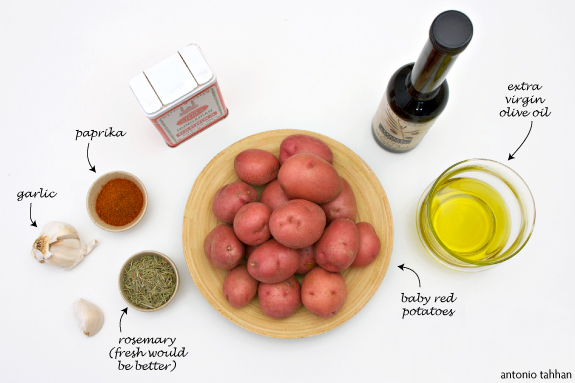
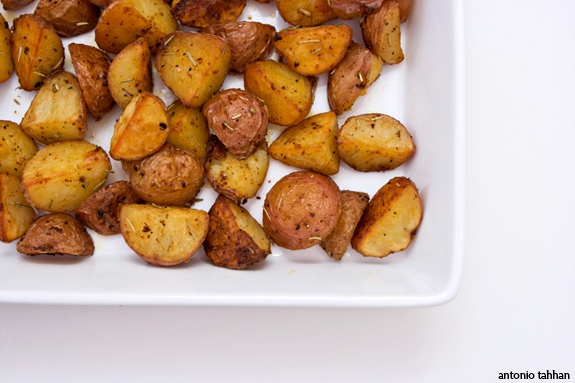
In the mean time, I've been strategically trying to use up all my produce and perishables for the past couple of weeks. Today I chose to write about roasted potatoes because they're a healthy alternative to fried potatoes, but are still popular with the kids. They're great in lunch boxes or afternoon snacks, and easy enough to make in large batches. There are a few steps, however, to ensuring a perfect roast with an extra crispy exterior and ultra creamy inside.


Preparation is simple. It makes a big difference to scout out good potatoes for this dish: small, firm and tight skin. I prefer reds simply because they have a higher sugar content, so they tend to caramelize better than other potatoes in the oven.


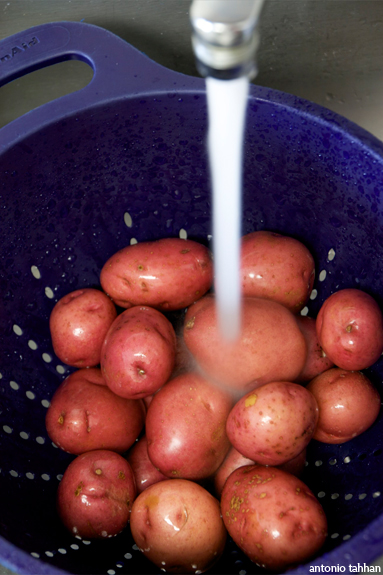
Since potatoes grow underground, you'll want to give them a quick rinse before you roast them. Make sure to pat them dry so that the outsides crisp up.


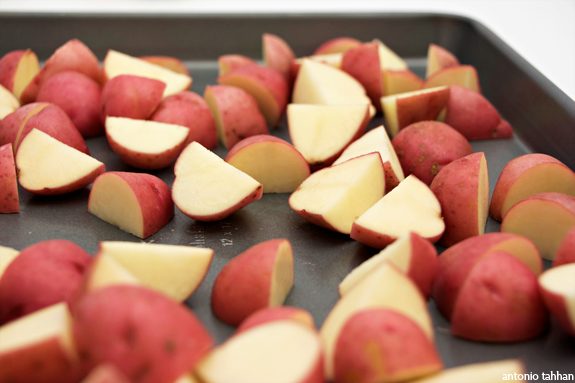
It's also important not to crowd the potatoes in a pan, otherwise they will still steam, regardless of how well you've patted them dry.


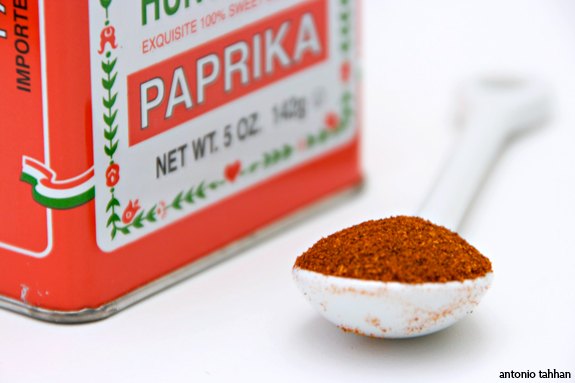
Although I usually use Spanish paprika, or pimentón, it's a lot easier to find the Hungarian variety at my local grocery store. My inspiration for using paprika in my roasted potatoes came from patatas bravas -- a classic tapas made from fried tomatoes covered in a spicy pimentón-base sauce. If you can't find Spanish paprika near where you live, Amazon is where I usually buy from.


Once they come out of the oven, they can be eaten hot or at room temperature. Enjoy!

Click here for the recipe.


This post was written by Antonio Tahhan


Are you interested in contributing to The Daily Tiffin? Drop us an email: thedailytiffin@gmail.com. We look forward to hearing your ideas.
Nursing: A Journey to a Destination

Thursday, October 15, 2009

Posted by Hilda


Any men out there who start to read this, gag and want to skip this article, if there is a woman in your life who might get pregnant and deliver a child she intends to nurse, I'd try to at least get halfway through it. I promise I won't get graphic.

Disclaimer: This post is meant in no way to make a statement about the merits of nursing over formula or vice-versa. I don't see anything wrong with feeding your baby formula, I was a formula-fed baby and I turned out ok (I think anyway).

The last time we saw our pediatrician at the 6-month appointment, he took one look at my baby and said "she looks perfect, she could be an advertisement for breastfeeding." I think it would be hard to describe the sense of relief I felt when he said that. I didn't originally think that I would be writing about breastfeeding/nursing here, but when I told K.'s Godmother what the doctor had said, she immediately insisted I had to write about it for my next DT post, if only to let other soon-to-be mothers know that as hard as it may be in the beginning, it can end up being perfectly fine. You see, it was very difficult for a while. 

In England, midwives are the bulk of the maternity unit staff, rather than nurses, and because they are the main baby birthers in the public system (a doctor is called in to supervise if there is an issue of some sort but otherwise midwives often deliver babies themselves), many also consider themselves to be the authority on everything pregnancy and baby-related; this results in, over a post-birth period of 48hrs, receiving the advice of at least four different midwives on the proper nursing positions, times, frequency, etc... and they all have different ideas about every part of the process, all in contradiction with each other. The day I left the hospital, I had a breakdown on the phone with my sister because my baby seemed a bit jaundiced and had needed hardly any diaper changes that day, so she couldn't possibly be well; surely I was doing something wrong. The midwives weighed her, checked her bilirubin level (for jaundice), reassured me that she was fine, and off we went with a stash of painkillers for me.
The timeline from then on went basically like this:

Day 4 - Morning: Community midwife comes to the house as part of the National Health Service. First helpful with tips to improve latching position and keep baby awake during a feed, but also thinks baby looks very jaundiced and even though the hospital pediatrician has declared her to be fine, I become extremely anxious.
Day 4 - Afternoon: Our pediatrician checks baby over thoroughly and plots out her bilirubin level on a special hospital jaundice chart so we can see that she's fine. He declares her to be in very good health. Says to put her in sunlight for the jaundice.

I'd been told that it would take 6 weeks to establish the nursing completely, but I'd also been told that I seemed to be a natural at it and that I had the latching down properly somehow from the beginning, the main issue was that I had this baby who just couldn't last more than a few minutes into a feed without falling asleep and I was having a great deal of difficulty keeping her awake long enough to eat.

Day 6: Baby has slept entirely way too long at night and I haven't been able to feed her at regular intervals. Am worried about my milk coming in and the supply being sufficient with a baby that doesn't create a demand (it's a demand-supply system). Midwife visits and weighs her, declares she is not putting on enough weight. We should supplement feeds with formula.
Day 8: I've developed an infection and must urgently return to the hospital, nursing baby in tow.
Day 9: I have an operation under general anesthesia which makes me drowsy and sick to my stomach. I am exhausted and have a hard time waking regularly to feed a baby I can't wake to eat and who won't stay awake through a 45mn feed. Am convinced my supply is not going to get established and my fatigue only augurs bad things when I'll get home. Am hysterical on the phone to my sister about the baby not putting on enough weight and my supply dwindling. Am sent home with more painkillers and antibiotics.
Day 11: Midwife visit, I am advised to really supplement more with formula as she is not gaining enough weight, and by then am a complete mess. Tired, in pain, with an adorable baby who seems fine and alert when awake but who is asleep when the midwife visits and isn't gaining weight quickly enough. Try to pump to increase my low supply.  I supplement grudgingly, feeling excessive guilt even though I know very well that it would be fine if I ended up not nursing and giving her formula, after all I was a formula-fed baby. No matter how much coaxing we do or what we try, she takes almost no supplemental formula.

Day 16: Midwife visits, the baby is an ounce shy of her birth weight and a few days away from being declared as"failure to thrive". Am about ready for the loony bin. Make my husband buy a medical scale most often used for weighing babies so I can weigh her every or every other day.
Day 17: The health visitor, a person who basically checks in on the family from a child's birth until he/she is 5, comes by and I see my first glimpse of hope. She says that though she has no empirical evidence to support her thoughts, her experience is that in cases such as mine, as soon as the new mother stops taking the painkillers, the milk supply increases dramatically and the baby gains weight very well. I'd taken my last pill that morning and wait to see what might happen over the next couple of days.
Day 19: Even though I can't measure it, I know my supply has increased and baby is starting to wake up to the world, clearly the painkillers were not helping in this whole debacle.

Over the next few weeks, I had to sort through a number of other hiccups in the process (biting, soreness until I thought I couldn't possibly get through one more feed) until by about 6-8 weeks in, just as predicted, and in spite of everyone saying it would take me less time because I seemed to be doing well the first couple of days in the hospital (even though I wasn't), I'd figured out 95% of the problems and was nursing her fairly comfortably. I'm still nursing her now as she discovers solid foods.
I often thought about just giving up, especially since we'd found a brand of formula that she actually seemed to like when we first had to supplement her, the point being that it was only perseverance and the will to nurse her that got me through. During those first three weeks in particular, and still fairly often until she was about 2 months old, I never thought I'd make it this long or that the pediatrician would ever say that she looked wonderful and could be an advertisement for nursing.
I know this has been a long post, but I wanted to share that, just in case one would-be mom reads it and it makes a difference. Experiences like nursing that are very personal can make one feel very guilty or inadequate when they don't go well and it becomes hard to share, so if this helps even one woman out there, it's worth putting the rest of you to sleep.


This post was written by Hilda


Are you interested in contributing to The Daily Tiffin? Drop us an email: thedailytiffin@gmail.com. We look forward to hearing your ideas.
Immunization - Truth and Rumor

Wednesday, September 16, 2009

Posted by Hilda


My families are a bunch of trivia heads, both the one I was born into and the one I am now a parent in. I think asking us trivia questions incessantly and providing interesting trivia continuously was a way for my father to instill deep curiosity about everything in us.
On occasion, my father will ask me the same question, perhaps forgetting that he has asked me it before: What would you name as the three most important discoveries for mankind? My answer has always consisted of the same first two things: 1) Fire and 2) The Printing Press. The third one is not always the same depending on the occasion, and while he agrees with me about the first two, my father is always unerring in the third one: 3) The generalization of the vaccination process by Louis Pasteur.

When I was little, I don't think there was even a shadow of a doubt that I was going to be vaccinated. In fact, I can't recall there being any issues with vaccination during my lifetime except within the last five to ten years. In that time, the rise in instances of autism in young children has led factions of people to believe that vaccines and vaccinations in general are a direct cause of the condition.
So, to vaccinate or not to vaccinate? That is the question.
As the mother of a nearly six month-old baby, I'm going to be honest and begin this discussion by saying that my little girl has had her prescribed shots;  at two months, three months, four months and has just had a BCG shot which is recommended before the age of one in Europe. The vaccines that she has received so far are meant to protect her from Diphtheria, Tetanus, Whooping cough, Polio, and Pneumococcal(lung) and Meningococcal(brain) strains of influenza. The BCG is a vaccine against Tuberculosis. Further shots when she'll be thirteen months old should protect her from Measles, Mumps and Rubella. So it's obvious which side of this equation I fall under, but I'll break it down and see if it makes sense to you too.
Even before the mercury rumor, which persists to this day, the first rumor blaming vaccines was started by a group of researchers who published a study in the late 90s theorizing that the Measles, Mumps and Rubella vaccine (MMR) caused autism in a study they did of 26 children (12 with autism and 14 without). Yep, you read that right, 26 children, there's no zero missing at the end of that number.  The researcher who headed the study was very vocal about publicizing the results though the study did not prove anything. However, the said same researcher was later found to have hidden a conflict of interest involving funding from potential plaintiffs in a lawsuit against a vaccine manufacturer. Ten of the thirteen researchers who had published the original study later retracted their findings. Nevertheless, the rumor that vaccines caused autism was cemented into the psyche, and as the MMR debate was being fought, a new target was found in mercury.
The most persistent rumor in the anti-vaccination campaign has been that mercury found in a chemical known as thimerosal, which was used as a preservative in some vaccines, is the cause of higher rates of autism. However, upon doing extensive reviews of such a possibility, it was found that the quantity of mercury in thimerosal, measured in nano grams per milliliter in children after vaccination, is well below the acceptable level as defined by EPA standards. I trusted the reports I read because I was trained as an environmental engineer in college so I know about measurements like nano grams per milliliter (ηg/ml) up the wazoo as I had to study air, water, and soil pollution (did you know that if you work in the United States, the air in your workplace has to be recycled 5.4 times per hour? Yes, I'm so scarred I remember OSHA standards by heart twelve years after the fact). To be specific, the amount of thimerosal measured in children after vaccination was less than half of the acceptable amount.  Unfortunately, in this day and age of electronic communication, coming on the heels of the claims about MMR, the fuse had already been lit and spread in part by the New York Times and Rolling Stone and the thimerosal rumor grew to enormous proportions.
In my mind there are several things that are more likely the cause of autism, than just something as unlikely as a simple vaccine or set of vaccines. I apologize in advance to anyone with an autistic child who may read this but I do not pretend to be an expert, I am simply going forward with what some research, experience, and logic are telling me. Autism does not describe one particular condition, rather, it is a spectrum of disorders. This is why a condition such as asperger would be said to fall within the autism spectrum of disorders. My mother has asperger, some of the symptoms being stronger than others in her particular case. My paternal uncle, who is a mathematician, also falls within the general spectrum; though which one of the exact disorders he would qualify as having I wouldn't know. What I do know, from these two people close to me and many others mostly unrelated to me, is that many of the disorders which fall under the autism spectrum umbrella have only recently been identified and categorized as such, and that the diagnosis of many of these disorders is not always evident unless a person has a severe case of that particular category. In other words, what I've gathered from people of my parent's generation and above is that as recently as my parent's generation (the '40s and '50s) they weren't aware that there was any such disorder, they were simply considered to be relatively slow, quirky or eccentric. The octogenarian mother of a man I know who is in his early 50s didn't know that he suffered from ADHD (Attention Deficit Hyperactivity Disorder) until he was diagnosed a few years ago. As she recanted, she had always thought that he was simply over energetic, this being his quirk compared to her three other children. To me, this translates to the steady increase in the reports of autism as actually being a function of our recent heightened awareness of its distinct categories rather than its sudden increase as a consequence of vaccination.
Moreover, autism, in severe cases, is often diagnosed in young children as early as one year old. This is right in the middle of the standard vaccination timeline and I, as a new mother, can attest that I would consider it odd if my perfectly normal-seeming child suddenly started displaying autistic behavior shortly after being vaccinated and might want to think of that as the possible cause for her sudden change in behavior. I completely understand the urge to find a concrete cause for something like this happening to one's child as the more concrete the cause, the more possible a specific treatment and/or cure might be. However, it should be considered that the urge to blame vaccination comes partly from the fact that when children are this young, vaccination is one of the only things that we as their parents can control completely since they cannot fully communicate with us yet and we have little or no control over a number of other factors in their environment such as pollution or allergens and, for that matter, many other things which surround us daily but which we've come to accept as the natural state of the 20th and 21st century life. It's important to remember that while we can control the administration of vaccines to our young children, unless we are doctors or biochemists ourselves, we don't fully understand them either, and understanding something only partially may be worse than not at all in some cases like this.
Finally, if I haven't caused you to nod off on your keyboard by now, the third and last part of this equation is the fact that some of the diseases which our generation, and now our children's generation, are routinely vaccinated against used to kill scores of infants and adults alike. Because the population of people, however small, who are not vaccinating their children is on the rise, diseases such as measles, which was considered to have been eradicated in the United States in 2000, polio and mumps are now on the rise again, with outbreaks over the last few years. I think it's hard for my generation to comprehend diseases like polio because we were vaccinated against them. We didn't have to endure them as people of our parents' generation had to. The risk of my daughter catching one of these diseases and perhaps dying from one or more of them if she were not vaccinated, is higher and more likely than her developing autism from the composition of the vaccine; particularly since the causality between vaccination and autism is not proven. So I think in the end it must be pretty clear why I'm in the vaccination camp.
I have to note the following: All children are, of course, individuals and it is important to take family history with allergies and adverse reactions into account when deciding whether or not to vaccinate a child.

I can't remember now what other answers I've given my father when it comes to the third most important discovery for mankind, but now that I have a child who is being vaccinated, I don't think I'll ever forget that that is probably the best third answer I can come up with. Perhaps that has been the point of his asking me repeatedly over the years, to see if I would come to this realization when I had children of my own. Thanks Dad.


This post was written by Hilda


Are you interested in contributing to The Daily Tiffin? Drop us an email: thedailytiffin@gmail.com. We look forward to hearing your ideas.
A world outside of mozzarella & pepperoni

Sunday, June 28, 2009

Posted by Antonio Tahhan

A simple google search for kid-friendly recipes is scary. What shows up, in fact, is a harrowing slew of butter-saturated, sugar-filled recipes written with a complete disregard for health. I discovered this last week because I was looking for just that - simple recipes that I can make with kids.

My friend Beth invited me to cook in front of a class of kindergarten students. Her son is in the class and they were looking for someone to do a cooking demo for the kids' end of the year party - I was flattered that they thought of me and happily accepted.

I took this as my tiny opportunity to make a difference in the way these kids looked at food. While this was not the time to introduce them to the delicate flavors of perfectly-seared scallops or steak tartare, I wanted to cook with them something they're familiar with, but probably never had before. I decided to let them make their own pizzas. Instead of just mozzarella and pepperoni though, I brought with me a ton of different vegetables and all sorts of sauces for them to experiment with. Well-aware of the fact that the kids will have a short attention span that rivals mine, I also brought with me my pizza paddle and pizza stone so they could take turns sliding their pizzas into the oven.


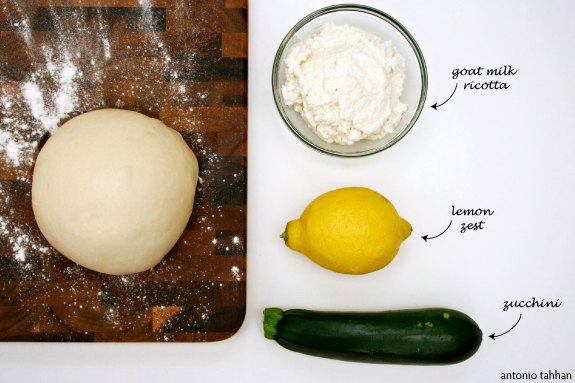
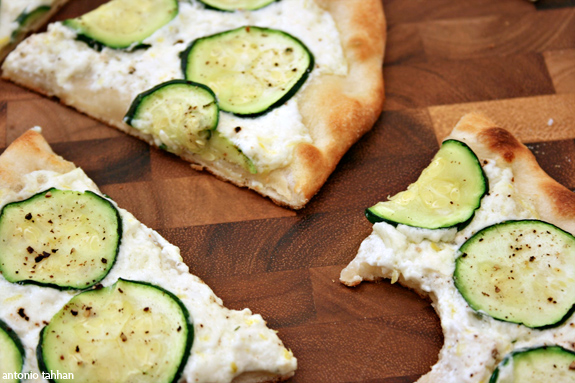
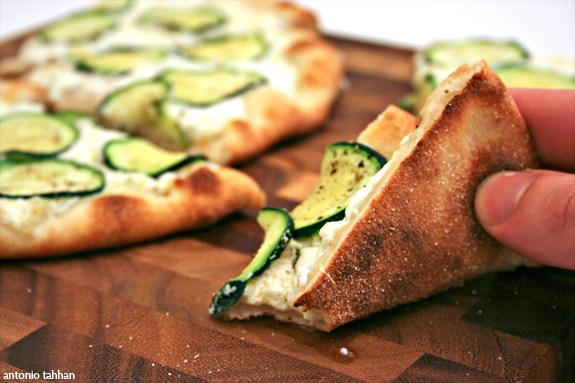
This is my first article for The Daily Tiffin, and it couldn't have come at a better time. Inspired by my pizza event last week and the smoldering heat of the summer, I decided to make a lemon-infused, goat ricotta, white pizza topped with thinly sliced zucchini. The flavors are light, refreshing, clean - perfect for the hot summer days ahead.


Count them - four ingredients; five if you include the extra virgin olive oil. This means no skimping on ingredients! I tried this same pizza with regular ricotta and it doesn't work. The wow factor just wasn't there. If you absolutely cannot find goat-milk ricotta, however, not to worry. Mix a semi-firm chevre (like Spanish Capricho de Cabra) with some good quality, fresh ricotta and you'll get a similar result. Like I said, it won't be spot-on, but you'll get pretty darn close.


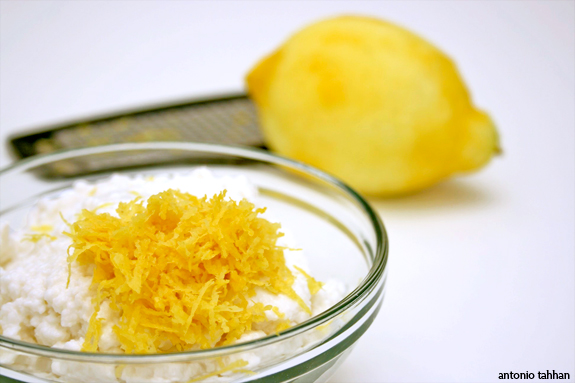
The lemon zest in the ricotta serves two purposes. Not only does it heighten the flavors of the goat cheese, but it also gives the pizza a clean, crisp flavor. If you can get organic lemons, I recommend them because their zest tends to be more flavorful than their non-organic buddies.


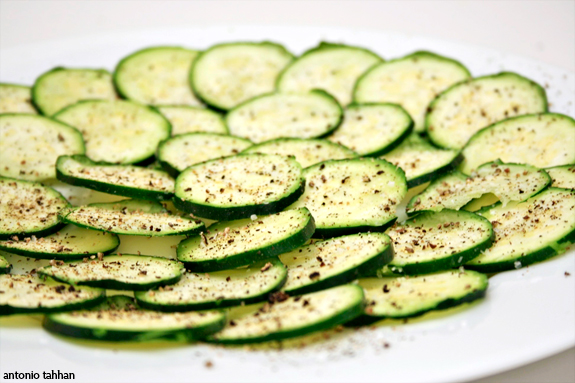
Zucchini in general has lots of moisture and moisture is the kryptonite, so to speak, of pizza. To remove some of this excess moisture you'll want to thinly slice the zucchini (preferably with a mandoline) and fan the slices out on a plate so they're not on top of each other. Then season the slices with salt and pepper and the salt will start to break down the cell walls of the zucchini, and thus allowing it to give up some of that moisture. Soak it up with a paper towel and your ready to roll.


The kids were shocked when I hinted to the idea of a pizza without red sauce. Their facial expressions were absolutely priceless. And although not many ventured down this path, I feel like those that did may have a bright culinary future ahead of them.


Recipe:
Ingredients:


  • 24 oz. pizza dough

  • 2-3 tbsp extra virgin olive oil

  • 1/2 lb goat milk ricotta

  • zest of 1-2 lemons

  • 1 zucchini, thinly sliced

  • salt and pepper, to taste


Putting Them all Together:

  1. Zest the lemon(s) and stir the zest into the goat ricotta

  2. Thinly slice the zucchini (preferably with a mandoline), fan out on a plate, season with salt and pepper, and cover with a paper towel to soak up some of the moisture.

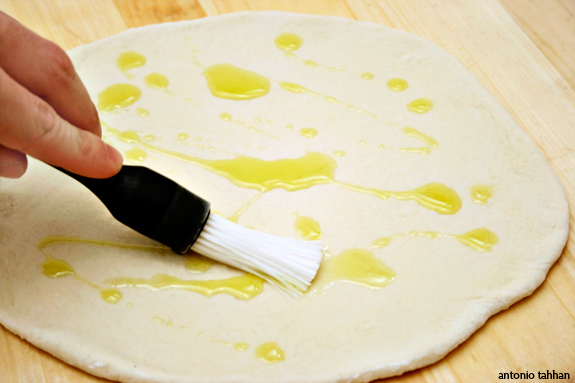
  3. Stretch pizza dough to approx 1/8" thickness - this pizza is better thin than thick - and brush a thin coat of olive oil over the top.

  4. Spread the goat cheese mixture over the top and top with the thin slices of zucchini.

  5. Preferably bake on a hot (550 degrees F) pizza stone for 5-7 minutes or until the crust gets golden brown.


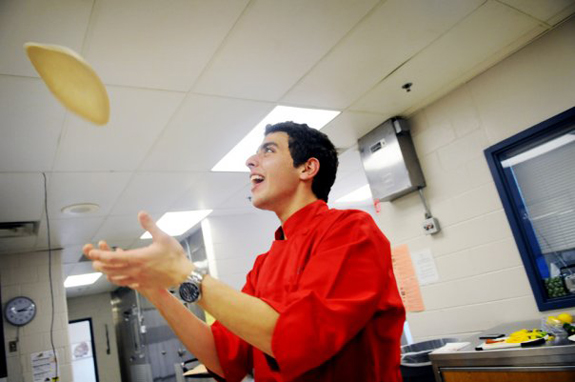
This is why everyone should invest in a pizza stone:


This post was written by Tony


Are you interested in contributing to The Daily Tiffin? Drop us an email: thedailytiffin@gmail.com. We look forward to hearing your ideas.

THERE'S SOMETHING ABOUT YOGURT...

Thursday, April 16, 2009

Posted by Deeba PAB

There's something about YOGURT, & I'm hooked to it. Sometimes I think I'm taking it too far, & substituting cream with yogurt too often, but it's a habit that grows on you. On indulgent days my panna cotta will have cream, but otherwise, it'll have a thick hung yogurt, referred to here as 'curd cheese' or 'shrikhand'. Yogurt is the most versatile ingredient in my fridge, & the benefits are manifold. Amongst others, yogurt
  • may help you to live longer, and may fortify your immune system
  • can significantly improve the cholesterol profile
  • contains lactoferrin, an iron-binding protein that boosts the growth and activity of osteoblasts (the cells that build bone)
  • has Lactobacillus, a probiotic (friendly) bacteria which offers "remarkable preventive and curative" effects on arthritis
  • strengthens the immune system
  • is helpful in the battle against ulcers

Chocolate Yogurt Cake

Yogurt is a very good source of iodine, calcium, phosphorus, and vitamin B2. It is also a good source of protein, vitamin B12, potassium, molybdenum, zinc and pantothenic acid. These 10 nutrients alone would make yogurt a health-supportive food. Some of the most interesting health information about yogurt comes from its potential inclusion of live bacteria.

It's no secret at home that I make my ice-creams/frozen yogurt desserts, my egg less cheesecake & sour cream etc with yogurt, & the results are delicious. Might well be a good idea to introduce kids to a 'yogurt habit' when young. Mine have been hooked on to it since they were very young. Come summer, winter, spring or fall, there has to be fresh, home-made, chilled yogurt every single day. The daughter isn't so much of a yogurt addict any more (teen thingy?), but the son is a complete 'yogurt freak'! He eats 2-3 bowlfuls with every meal, just plain, sans sugar. The daughter will usually add a tsp of sugar but wolf it down anyway. I set 2 litres of yogurt every alternate day... it's that much part of our existence!! I use it in sauces, in kebabs & curries, in lassi (sweet & sour), to make dips, to make sour cream, to make my cheesecakes (with eggs & without), to make ice-cream, to make chocolate yogurt cake, to make muffins...oh the list is endless! Here's a simple David Levobitz recipe I adapted. It might be a good way to introduce yogurt to frozen desserts this summer, but be warned, it's very addictive. And oh yes, you don't need an ice-cream machine to make this one!

Frozen Strawberry Yogurt
Adapted from David Levobitz
Ingredients:
1 cup (240g) hung curd
1 pound (450g) strawberries, rinsed and hulled
2/3 cup (130g) sugar
1 teaspoon fresh lime juice
Method:
Tie the yogurt in a cheesecloth and let it sit in a strainer in a bowl overnight or for at least 2 hours. This will help drain off all the whey and result in a very creamy frozen yogurt dessert. (I find overnight a better option)
Cut the strawberries and toss them in the sugar until the sugar begins to dissolve. (I used vanilla sugar).
Blend it together to a puree. (Strain if you don't like the seeds in)
Next, blend in the yogurt and lime juice until the mixture is smooth. Adjust the sweetness if required.
Freeze the mixture in a wide dish or plastic container. (The larger the surface area, quicker the freezing – since we have to pulse this mixture a couple of times).
Keep checking on the mixture every 30 minutes or so and use the stick blender to break the icicles, 4, maybe 5 times. (I used a sturdy whisk).
Once it's almost set, you can add a handful of finely chopped fresh basil, or else, some chopped pistachio nuts if you like. Just plain is good too!
Garnish with sliced strawberries & a sprig of basil, or, chopped pistachio nuts & mint!


This post was written by Deeba


Are you interested in contributing to The Daily Tiffin? Drop us an email: thedailytiffin@gmail.com. We look forward to hearing your ideas.

5 Surprising Facts for a Healthier You!

Friday, March 27, 2009

Posted by Mansi

Ok, so everyone knows Exercise is great for your body and mind, and that drinking 6-8 glasses of water is highly recommended to maintain your physiological activities. But besides the well-known stalwarts like these, you'd be surprised to find some fun trivia here that can actually come in handy. What's more, they are treated as Facts, rather than Conjecture, and that's what made me so interested in sharing these with you. A few of these tips below talk of simple life changes or habits that wouldn't require much effort, have absolutely no side effects or risks attached to them, and can actually be fun! So starting today, make sure you adopt at least one of these 5 ways to a Healthier you, and a healthier lifestyle!

1. Switch from Sugar to Honey - You can easily lower your cholesterol intake by substituting honey for your sugar consumption. Honey can slow the oxidation of bad (LDL) cholesterol, which in turn helps increase your good cholesterol, and attain a healthy overall level.

2. Eat your Apple with the Peel - Research from several organizations, including a recent study from Cornell University has shown that chemicals contained in apple peels can inhibit the growth of breast cancer, liver cancer, and colon cancer cells.

3. Rosemary & Lavender are great Anti-Ageing Agent - I love the fragrance of Rosemary, and now that I know that it can lower levels of the stress hormone cortisol by as much as twenty-five percent, I go and take a whiff of it every morning and evening! The scent of Lavender is not only pleasing, it also encourages your body to get rid of free radicals, which in turn slows down the process of aging and disease.

4. A Quick Stress-Buster Tip - Drink a glass of cold water, then go for a walk outside. The water gets your blood moving and the air invigorates your senses by stimulating the endorphins that distress you, making you instantly relaxed.

5. Eat Dark Chocolate & Kiss Someone! Ok, this one's really funny, but it is backed by logic! Chocolate is a great anti-oxidant and stress-buster; it instantly uplifts your mood. So eat a small piece, and go kiss your spouse, partner or kid, and pass on the happiness! What's more, kissing produces more saliva, which actually helps protect your teeth's enamel and gives it more life!

In this fast-paced life, its really hard to find a moment of relaxation. But simple changes like these can come in handy! Just print out a list and stick it to your fridge or clipboard, and try at least 2 things every day! That way you'll surprise yourself with something new each day, and also help yourself to a healthier body and mind!

This post was written by Mansi

Are you interested in contributing to The Daily Tiffin? Drop us an email: thedailytiffin@gmail.com. We look forward to hearing your ideas.

5 Essential Practices for a Successful Diet

Saturday, February 21, 2009

Posted by Meeta K. Wolff

Now that the year is well underway, many people are trying harder than ever to hold firm to their resolutions, many of which include a healthier way of eating. Whether you are looking to shed a few holiday pounds or completely transform your look, there is hope when it comes to dieting. With a few simple guidelines, diets can produce some amazing results. Keep reading for some great practices that will make your diet a successful endeavor.

Learn the Principles of Your Diet

How is your diet plan ultimately going to help you reach your goals? Will you need to count calories or watch carbs? Perhaps you will need to do a little of both. Take some time to learn how the body uses food and what kind of diet will truly suit your weight loss needs. Knowledge is power, so take some time to research the best methods for achieving your desired results.

Find New Recipes

The internet is an amazing resource for food lovers of all walks of life. A simple search will give you access to thousands of great recipes, all of which can be tweaked to meet the needs of your specific diet plan. Learning new recipes is a great way to find new flavors from the comfort of your own home without having to place undue strain on your pocketbook.

Avoid Eating Out

Eating out provides many temptations that could ultimately subvert your dietary goals. Many restaurants claim to have healthier or lighter items, but these items or only healthier or lighter when compared to other menu items. Salads at fast food restaurants, for example, can have as many or more calories than a large burger and fries once the protein and dressings are layered on. When you cook at home you know what you’re getting, plain and simple.

Keep a Food Journal

Keeping a food journal can serve many useful purposes when dieting. First of all, it helps you track what you’ve been eating, as well as what you liked and didn’t like about these items. You can track your portions and the ingredients, even the cost of your meals quickly and easily. Make it an interactive journal by pasting in photos of your meals or even recipes and responses from others who have tried your food. Doing this is a great record of your diet and a resource for the future.

Keep With It

Developing the bad habits that caused you to either want or need to develop took time, so expect your good habits to take a while to develop. Thirty days is the standard amount of time to supposedly change habits, so keep at it. Dieting is not always easy, but can be facilitated by practicing a few of these suggestions.

This post was contributed by guest writer Holly McCarthy, who writes on the subject of nursing school.


Are you interested in contributing to The Daily Tiffin? Drop us an email: thedailytiffin@gmail.com. We look forward to hearing your ideas.

Vegetarian Food Pyramid – A Series

Monday, January 19, 2009

Posted by DK


In recent years, with words like Diabetes, Cholesterol and Blood Pressures becoming commonplace in many households, we all are turning to crash diets, low-carb foods and probably to Jenny Craig’s. And no – I dint leave out the obvious “exercise” by mistake. The fact is, that anything worth taking effort, is thrown into the back burner by many of us. I am not going to elaborate on the benefits of exercise, it has been insisted at Daily Tiffin often enough. I am going to concentrate more on foods which not only help to us get healthy but also help to reduce the unnecessary bulk efficiently, without having to go through yo-yo dieting.

Vegetarian foods need not be bland or boring. Consuming whole foods mean that our intake has not been heavily processed by way of chemicals, additives or unnecessary flavorings. Such foods are loved by our body and regular ingestion of these will purge our system of harmful toxins. The purpose of this series is to talk about such foods, expand our knowledge base more about these ingredients with some basic recipes, which are delicious and colorful to boot, so that we can start adding them in our day to day meals. One doesn’t have to become a vegetarian to be healthy – it simply requires us to include some good food options to make a difference to our lifestyle.

I. Grains.

Let me kick start this series with the staple of all foods - Grains. They are available in so many forms from whole grains, rice, cereal grains to flours and the options are endless. They have been cultivated all around the world and are a staple in most of the countries. Each one of them have their own value added benefits which make them one of the most sorted out food groups by health gurus.

1. Oats

This is commonly seen in almost all our pantries. Oats are warming, filling and are popular grains in many places around the world esp. Scotland, where they are usually enjoyed as pancakes, oatcakes and as hot oatmeal. They are available in a variety of forms – as regular oatmeal, rolled, flaked or as oat bran. Here are the various types and their ways to cook and benefits.

Types of Oats

a. Oat Groats.

These are whole oat grain - the hulled whole kernel. They have a nutty flavor and a very chewy texture. They are best in breakfast cereal although from my experience they are an excellent rice substitute too. Have you ever tried to make patties with these? They are excellent – taste wise as well as nutrition wise.

How to Cook Oat groats?

Clean the groats well with cold water. Soak Oat Groats overnight. One can use any of the following methods to cook them.

Stove top method:Simmer 1 cup of groats with 2 cups of water, salted. One can also use milk or broth instead of water. It takes about 45min to 1 hour

Rice Cooker method: The process is similar to cooking rice. Use 2 cups salted water/broth to 1 measure Oat groats. It usually takes me a little more than 45 minutes.

Crockpot method: Although I have not tested this method personally, this works very well for an acquaintance of mine who uses 2-1/2 cup to 3 cups salted water for 1 cup of oat groats for cooking in her crock pot on low overnight.

b. Oat Bran

Image courtesy : Purcell Mountain farms

This is the outer coating of the oat grain and is rich in fiber. These are mostly available in your local health markets. The bran is an excellent addition to cookies, muffins, breakfast, breads, pancakes, cereals or as topping. I have sometimes used them even in Roti’s (Indian flatbreads) to good effect. It is better to buy Oat bran in small quantities since they go rancid quickly. Freezing them prolongs the shelf life.

c. Rolled Oats

Rolled oats are nothing but groats which have been pressed flat by heating. Rolled Oats are found in different forms and one would often find these common types in the market:

1. Old Fashioned Rolled Oats:

They are made by heating groats and flattening them with a roller. The very thin rolled version of the same produces very creamy oatmeal than thickly rolled ones. The Quaker Old Fashioned Rolled Oats are thinly rolled and theirs is considered the industry standard and considered to be the regular Old fashioned rolled oats. The thicker ones are referred to as Thick Old Fashioned Rolled Oats.

How to Cook Old Fashioned Rolled Oats:

Stove Top Method: Bring required quantity of water or milk to a boil. Stir in the oats and stir occasionally for about 5-8 min over medium heat until done. Use sugar or salt as per taste.

Microwave Method: Combine the oats with either milk or water along with salt(or sugar) in a microwave safe bowl. Microwave for about 3-5 min. The cooking time varies depending upon your microwave. Stir well and then serve , topped with fruit of choice, with honey or raisins etc.

2. Quick- Cooking Rolled Oats:

Just as the name emphasizes, these are quick cooking variety of Oats and this is because these are made by flattening the pre-cut groats and rolled very thinly using the rollers. Although it is called as Quick cooking, it takes more or less the same amount of time as that of Old fashioned Rolled Oats. Cooking Instructions are same as that of Old Fashioned Oats. I find that it takes about 2-4 min to cook these quick cooking oats.

3. Instant Oats:

Usually there is no cooking involved in these varieties and just adding it to warm milk/water is enough. These are precooked, hence the speed at which it is done. Although they are convenient, it is not advisable since it is loaded with preservatives and other additives. Instant Oats = Instant harm! :) Any recipe asking for Instant Oats can be substituted with quick cooking Oats.

d. Steel Cut Oats ( also referred to as Scottish Oats, Irish Oats or pinhead Oats)

These are immensely healthy since they unrefined and are closer to the natural oat grains. These are formed by cutting the oat groats into smaller pieces. As the name suggests they form the basis for making the Traditional Scottish porridge. They take a little longer time to cook than regular oats.

How to Cook Steel Cut Oats:

Stove-top Method : For 1 cup of Oats bring about 3-4 cups of water to boil in a saucepan and stir in the oats. Keep the heat on high and keep stirring until it thickens up – approximately 5-8 min. Once it becomes thick, stir well, lower the heat to a simmer, cover with a lid and let it cook for another 30-45 min until done. A little milk can be added once done.

Microwave Method: This is not the best method since its need stirring quite often so that the oats does not stick to the bottom. But if needed, follow the same method as mentioned for stove top method taking care to stir every 5 min. The cooking time, although is much lesser taking approximately 20-25 min, again depending on the microwave.

e. Oat flour

These are excellent alternatives to refined flours in baking, although it requires other flours to rise since it does not have any gluten required for bread to rise. If making quick breads, then no additional flours is necessary. Oat flours can be made at home very easily by grinding rolled oats in a food processor. It takes about 2 cups of old Fashioned Rolled Oats to make 1 cup of oat flour.

f. Oat Sprouts

One of the best ways to consume Oats is by sprouting them - which are much thicker than other sprouts. The benefits are countless and they are an excellent addition to – breads, soups, smoothies etc. Make sure you use unhulled Oat seeds for sprouting. Oat groats do not sprout.

How to Sprout Oats:

1. Rinse the oats in cold water until the water runs clear. Transfer into a wide-mouthed jar or sprouting vessel and cover it with twice or thrice the amount of water. Cover the jar and let it soak for 8 hours.

2. Drain and then rinse the oats. This time return them into a jar without any water and cover the mouth with a cloth. Direct sunlight should be avoided.

3. Repeat step 2 every 8 hours for 2-3 days until you see the sprouts. Rinse once again and store it in the refrigerator. They keep well for 10-14 days.

Health Benefits of Oats

Oats is one of the nutritious grains whose health benefits are immense. From helping to lower the bad cholesterol (LDL) while increasing the good cholesterol (HDL), to helping prevent certain cancers, Oats are especially considered to be a boon to people suffering from Celiac disease. They are high in fiber, phytonutrients, Vitamins E and B as well as iron, potassium, magnesium and calcium.

Oat bran consists of bulk of dietary fiber of the grain. Oat Sprouts are rich in vitamins and minerals including essential amino acids and proteins. The whole grain oats is said to contain 7 B vitamins and 9 minerals and twice the protein content as that of wheat. Isn’t that amazing!

What better way to start a day,knowing that every spoonful of that simple oatmeal is loved by our body.

This post was written by Dhivya


Are you interested in contributing to The Daily Tiffin? Drop us an email: thedailytiffin@gmail.com. We look forward to hearing your ideas.

Diets, Diets, Diets - Which One's For Me?

Saturday, January 17, 2009

Posted by Meeta K. Wolff

It’s funny how the new year begins with good intentions to eat better: eat less, more nutritiously, less- sugar, more vitamins. I presume that several of us have “loosing weight” as one of the resolutions on our list. Don’t worry you are not alone! January and February are probably the months when people start more diets than any other time in the year.

After the Holidays, I too have been feeling a little unsatisfied with myself. Too many sweets, too much eating and my pants were giving me signals that I needed to take action. I have always been very careful with what I eat. Being a mum of a 6 year-old I pay close intention that our meals are healthy and nutritional. So, a little indulgence here and there, when the bigger picture fits, is OK. However, my weakness has always been sweet desserts and treats and especially over the period of Thanksgiving right through to New Year’s I tend to indulge more than I should.

The result is often that besides my scales showing me things I do not want to see, my energy levels are at a low, I feel down and am often easily irritable. It’s not surprising really – because the more sugary foods I eat the more I crave and these bad sugar and carbohydrate treats simply causes me to feel bad.

Sound familiar to you? If it does than it I am sure you have certainly considered going on a diet to get rid of the extra weight and to start a new regime that will make you feel better.

Generally there is nothing wrong with a diet but one really should consider the contents of the diet and exactly what it preaches. A diet that revolves around drinking powder mixed shakes all day and a big meal in the evening cannot be a healthy option.

It should not be only about loosing weight, it should always be about keeping your body fit and healthy. My dad, who has paid meticulous attention to his food and nutrition, always tells me that our bodies are the running motors and we have to look after this motor throughout our lives. No wonder at the age of 68, he still weighs exactly the same as he did 25 years ago and has the energy of a powerhouse (bless him)!

For me a diet has to be something where I know I am eating sensibly and my food options are healthy. As I reviewed several diets over the past 8-9 months I was amazed at how many were promising a loss of a lot of weight in the shortest of time. We all know that these crash diets are not effective. As soon as we begin to eat “normally” again we put all the weight back on, if not an additional kilo or two. To avoid the yo-yo effect a sensible diet will offer you a better eating plan, offer you loss of weight over a longer period of time, recommend sport and exercise and explain that the diet is more about integrating a healthier meal plan into your lifestyle. It is something you then live by.

As I mentioned above I have been looking into the subject of diets for several months now. Mainly because I was interested in Ayurveda cooking, the glycemic index and the South Beach diet. The more I read about these topics the more I became aware that it was not a “diet” in the way we would consider it to be – it was a lifestyle. These programs do not promise you “loose 10 kilos in 10 days!” but rather promise you a healthier lifestyle when we change certain aspects of our eating habits.

What I have tried to do in this post is summarize a few of these healthier dieting options, listing the advantages and disadvantages of the respective diets. Please remember I am not a dietician or a professional nutritionist and these ideas, recommendations and thoughts are based on my research and common sense!

Ayurveda Diet

This diet is based on the 3500 year old traditional Indian treatment methods. According to the Ayurveda teachings, the human is one entity of body, soul, spirit and the environment.

Three biological forces, called Doshas, interact with and effect every human: Vata, Pitta and Kapha. These three forces define the physical health of the person. With overweight people, for example, it is often the Earth force Dosha Kapha that is strongly distinctive.

The Ayurveda diet consists mainly of salads, vegetables, milk and dairy products, oil and ghee (clarified butter). Meat, fish and eggs are allowed in moderation. For those wanting to loose weight alcohol should be avoided, instead drink a lot of warm water and herbal teas.

Nevertheless, there are no strict dogmas in the Ayurveda philosophy. One should simply enjoy each meal and keep in mind that with the consumption of food they should establish a balance with body, soul and mind.

Advantages

Those who like exotic spices and flavors will love the dishes and food in the Ayurveda diet. Positive is certainly the higher proportions of raw vegetables and fruit – the vitamin and mineral supply is covered. Ayurveda is a lifestyle and the engagement with ones own body and nutrition, the meditation and massage leads to a relaxed relationship with ones own body. This in turn motivates to really think about the healthier aspect of dieting.

Disadvantages

Generally speaking the Ayurveda diet does not do any harm – the only fact is that there is no scientific proof that backs weight loss with this diet. Furthermore there is some skepticism from dieticians with regards to certain aspects of the Ayurveda diet – for example eating ghee (pure clarified butter) for breakfast.
You might not notice a massive weight loss with this program, but combined with a regular fitness regime, this certainly is a very healthy approach to improve your eating habits.

Further reading tips:
- Ayurveda and Food for Skin
- Eating for Balance

Glycemic Index Diet

The Glycemic Index Diet is based on the Glycemic Index (GI). According to the Glycemic Index Diet all foods can be eaten as long as they have a low Glycemic Index. It is not necessary to reducing the amount of calories and fat- consumption on the Glycemic Index Diet.

Basically, the Glycemic Index is a a type of a ranking system for carbohydrates based on their immediate effect on blood glucose levels.

The logic behind this is easy to understand. Carbohydrates with a high Glycemic Index are absorbed quickly by the body, which causes the blood glucose levels to rise rapidly. The body then releases large amounts of insulin in order to decrease the high blood glucose level. The excessive amounts of insulin lower the blood glucose level to such an extent that it can cause a mild form of hypoglycaemia. The reaction that your body gives you as a result of this hypoglycaemia is a feeling of hunger. Furthermore the higher levels of insulin make the decomposition of fat more difficult.

Those carbohydrates that have a low Glycemic Index are broken down slowly. This lower glycemic response means a lower insulin demand and a better long-term glucose control. This also means that the food fills you up for much longer.

In praxis this basically means choosing foods with a low glycemic index, which tend to be (but are not necessarily) healthier, nutrient-rich, less refined, and higher in fiber -- like whole fruits, vegetables, beans and whole wheat products.

Advantages

Following the Glycemic diet generally means a permanent change in your eating habits. Like the Ayurveda Diet, it is not a quick method to loose weight, but a philosophy one lives by, which not only will keep you at a steady weight over a longer period of time but also help to eat more nutritiously.

For this reason, here in Germany the Glyx diet (as it is called here) is often reviewed as a positive diet.

Another positive effect is that you are eating plenty of fruit, vegetables and fewer processed products. Therefore your body is getting the right amount of vitamins and dietary fiber.

Disadvantages

The fact that bleached/white flour products, pizza and chocolate bars are unhealthy for us is not a new concept for most of us. In this respect, the idea behind the Glycemic diet is not a passing fad, but a sensible diet plan.  However as in all cases one should use common sense when choosing food items from the Glycemic index - after all a Snickers scores 55 on the Glycemic Index!

One other point of critique is that the Glycemic index does not only vary from food to food but also other factors play a role in the value. The method of preparation and the combination of the foods that are eaten are some factors that can change the value of the food item on the Glycemic index. For example a boiled potato rates medium (56) but baking it raises the value of the potato to high (85).

Further reading tip: The Glycemic Index Diet (Low Glycemic Diet)

South Beach Diet

The South Beach Diet teaches a way of life where you rely on the right carbohydrates and fats. This new way of eating allows you to live contently without eating the bad carbohydrates and fats. In contrast, when a person eats bad carbohydrates and fats they feel hungrier, causing them to eat more, which causes weight gain.

The diet, which was created by cardiologist Dr. Arthur Agatston,  is designed to work with your body safely and effectively. This diet works in three phases, the first two for a specific timeframe and the third phase for life. There is no calorie counting and food portions are not weighed with this approach.

The South Beach Diet allows you to eat three normal-size meals and two snacks each day. The meal plans are designed to be flexible and a variety can be enjoyed, based on what sounds good to you on any particular day.

In phase 1 of the South Beach Diet potatoes, rice, pasta, fruit, sweets, baked goods and alcohol are to be avoided. Phase 2 allows you to introduce good carbohydrates and low glycemic index fruits. With the first two phases completed, phase 3 provides a change in diet for life.

The success of South Beach Diet depends on the glycemic index. Rule of thumb: always choose low glycemic index foods with good carbohydrates. Phase 1 of South Beach Diet consist of low glycemic food. In later phases, you can mix foods with higher glycemic numbers.

Advantages

The well balanced mix of fruit, vegetables and good carbohydrates with vegetables fats satiates well, without the hunger pangs. Furthermore, positive is the high portions of fruit and vegetables, and the recommendation to eat a lot of fish.

Disadvantages

Phase 1 is a radical adjustment and that is why it is recommended to stick to it not more than 14 days as without fruit over a longer period of time you will be denying yourself nutritious vitamins.  Phase 1 is the strictest phase and eating eggs for breakfast everyday for 14 becomes rather monotonous. Furthermore, it is not recommended for diabetics and vegetarians.

Further reading tip: South Beach Diet - What is it?

This is just a basic summary of the three types of diets of several. It should be a used as a guideline to do your own research on these three diets. The reason I chose the three is basically because to me they are less of a diet to loose weight only, but a lifestyle - a philosophy to change your eating habits for a lifetime. The benefit is that you will feel good about yourself, you will naturally know how to make the sensible choices in life when it comes to food. The bonus is that you will be looking good the whole time.

I personally chose the South Beach Diet and have successfully completed phase 1 and really looking forward to phase 2. I have lost 2 kgs (approx. 4.5 pounds) already and am back to my "feel good" weight. The thing that amazed me the most was that it has shown me, I consume a lot of empty sugar. For example, I always took 1.5 teaspoons of sugar in my coffee - 3 cups a day that was 4.5 teaspoons per day. I've also become more aware of combining my foods correctly and controlling my carbs.

My eating habits previously were definitely not bad but I know how I can improve it for a healthier (maybe a sexier) me! In the future I will be orienting myself more on the glycemic index and choose the right type of foods that keep me filled longer.

One last word, any diet you do choose for yourself you have to remember that if it makes you feel weak, faint, or just not good then you might want to re-consider the concept of the diet. Exercising at least a half hour each day will improve weight loss considerably.

Stay healthy!

This post was written by Meeta

Are you interested in contributing to The Daily Tiffin? Drop us an email: thedailytiffin@gmail.com. We look forward to hearing your ideas.