Showing posts sorted by relevance for query written by Manisha. Sort by date Show all posts

Girls are Mean

Friday, January 11, 2008

Posted by Indian Food Rocks

Shocked? Dismayed? Aghast? I certainly was when the Principal of a local middle school opened his welcome speech to parents of new 6th grade students with this statement. He attributed most of the problems in middle school to girl cliques. Boys can be mean, too, he said, but the emotional manipulation that drives girl cliques not only creates serious issues between girls themselves and between girls and boys, but also pits boys against other boys. This was two years ago. I shook my head and filed it away for future research.

Unfortunately, I had to dig it up again within a few months when my sensitive then-3rd grader spent half hour crying her eyes out every day on her return from school. Yes, girls are mean and they start very young. It is easy to deal with in-your-face bullying but it’s not always easy to deal with subtle and sophisticated signals that are sent out by girl cliques. The movie, Mean Girls, may have been about girl cliques in high schools, but take it from me that girls encounter them much earlier – in the first few years of being in elementary school.

It starts small: through loose cliques, deliberate exclusions and a lot of hurt feelings. Some children make it unscathed because they are oblivious to the games being played by their friends. Sensitive children, on the other hand, bear the hardest brunt of this phenomenon; largely because they are sitting ducks for emerging Queen Bees as they hone their skills.


Queen Bee? Yes! The term is no longer just used to describe the clichéd over-aggressive soccer Mom but it is also used to describe one of the roles that a child may assume in a clique. According to Queen Bees and Wannabes by Rosalind Wiseman, there are seven roles that a girl may assume. These roles are not set in stone and one girl may lose her position to another as they play mind games with one another. As a parent, it helps to examine these seven roles to get a basic understanding of how to deal with the emotional baggage that starts accumulating and slowly chipping away at the self-esteem of your child.

  1. The Queen Bee: Through a combination of charisma, force, money, looks, will and manipulation, this girl reigns supreme over the other girls and weakens their friendships with others, thereby strengthening her own power and influence.
  2. The Side Kick: She notices everything about the Queen Bee, because she wants to be her. She will do everything the Queen Bee says. The Queen Bee, as her best friend, makes her feel popular and included.
  3. The Floater: She has friends in different groups and can move freely among them. She has influence over other girls but doesn't use it to make them feel bad.
  4. The Torn Bystander: She's constantly conflicted about doing the right thing and her allegiance to the clique. As a result, she's the one most likely to be caught in the middle of a conflict between two girls or two groups of girls.
  5. The Pleaser/Wannabe/Messenger: She will do anything to be in the good graces of the Queen Bee and the Sidekick. When two powerful girls, or two powerful groups of girls, are in a fight, she is the go-between. However, the other girls eventually turn on her as well. She'll enthusiastically back them up no matter what. She can't tell the difference between what she wants and what the group wants.
  6. The Banker: Girls trust her when she pumps them for information because it doesn't seem like gossip; instead, she does it in an innocent, "I'm trying to be your friend" way. This is the girl who sneaks under adult radar all the time because she can appear so cute and harmless.
  7. The Target: She's the victim, set up by the other girls to be humiliated, made fun of, excluded. She can be part of a clique or outside the clique. Either way, she feels isolated and alone.
I found this list both daunting and depressing, especially when used to describe elementary school kids. I then chanced upon an article on Scholastic's web site called Coping with Cliques by Ann Matturro Gault. She writes:
Research conducted by professors John Coie of Duke University and Ken Dodge at Vanderbilt University established five types of kids: popular, accepted, rejected, controversial, and neglected. Although these distinctions begin to emerge in 3rd grade, they really take hold in 4th:
  • Popular kids are socially skilled, academically strong, and well rounded. Everyone wants to be their friend.
  • Accepted kids are where the majority of children fit in. They are liked by their peers and do well academically.
  • Rejected children are openly disliked and tend to be aggressive. They lack social skills and often have academic and family problems (e.g. divorce, alcoholism, and depression). School bullies come from this group.
  • Controversial kids are liked by some but intensely disliked by others. They bring out divisiveness. As adolescents they engage in risky behavior — girls tend to be sexually active earlier; boys get into trouble with vandalism and truancy.
  • Neglected kids aren't liked or disliked. They fade into the background and have little social impact. They are, in a sense, invisible. Kids in this category tend to be academically high-achieving, but socially withdrawn. The more socially skilled have one or two friends, but are just as likely to be loners.

Where, in this matrix, did my child fit in? I had to figure out how an amiable and congenial little girl could suddenly be reduced to an inconsolable heap of tears. Was I in denial? That perhaps my child was not as proficient as I thought she was when it came to social skills? That she might be provoking the kind of behavior that made her feel excluded and neglected? I had to find out.

I talked with as many parents as I could. All of them resorted to marching into the Principal’s office to scream "bullying." In some of the cases, it stopped but in most cases, it resulted in more exclusion. It also did not help prepare the child to deal with more of the same behavior. I knew then that I had to approach this from another angle especially since I knew that the maturity level of my own child went from truly naïve to extremely logical, depending on the situation. I think it is also important to state that she was not being physically harmed. Her self-esteem and self-confidence, however, had dipped to an abysmal low.

While I could not ride the bus to observe children's behavior en route to school and back, I volunteered as a chaperone on just about every field trip where I rode the bus or I drove about five children to the destination. In addition to this, I volunteered in the school so that I could watch and experience the dynamics at play within the classroom and especially on the playground. My research was rather unscientific and I was very careful to play the role of an unbiased observer, difficult as it was.

This confirmed several things: I knew my child as well as I thought I did and that I was not in denial. It also told me that if we worked on building her self-esteem and her self-confidence back to where it was by focusing on her strengths and recognizing her weaknesses, she would be back to her normal springy humorous and happy self.

The first thing we did, as a family, was to reiterate that she was loved for who she was. That was all we did for weeks until she was ready to absorb more inputs. Then, we focused on her strengths. She reveled in this extra attention and started excelling academically, which is where her strengths lie. Her teachers started noticing her ability to think clearly and reason logically, and began challenging her in the classroom whenever they could. Soon, she was in demand as a project partner or elected to be the leader for a group project. There was new respect for her in the classroom but the problems on the playground and in the school bus persisted. However, the difference was that we were better equipped to deal with them now.

We impressed upon her that she had to make different choices when it came to the playground. So, instead of trying to do what the other kids did, she focused on what she enjoyed and wanted to get better at. She chose to take her jump rope to school and started practicing her jump rope moves by herself. It upset me to learn that she was playing alone but it was heartening to know that she was not staying in at recess. Soon, she had several other girls jumping rope with her. They had good-natured competitions and slowly, the jump rope games morphed into other games on the playground. She extrapolated this experience to the ride home on the school bus and it, too, became a non-issue. By the end of 3rd Grade, she had carved a niche for herself and she was far more comfortable with who she was and where she wanted to be. The mean girls did not matter anymore.

This is not to say that everything is perfect and hunky-dory now but things are a lot better. She has learned that she cannot change or control other kids' behavior but she can control her own responses. She walks away to protect herself from getting hurt. Other times, she confronts the other girls with what she thinks they are trying to do. It does not always go down well but they leave her alone. A curious fallout of this is that her 'services' are now frequently sought as an arbitrator in playground quarrels because of her ability to reason and be fair. She also knows her bounds and mitigates volatile situations by handing them over to the teacher-in-charge.

She has always been 'different' – in temperament, intellectual ability, ethnicity, and she is also strongly influenced by our values at home that, in many cases, are diametrically opposite to that of the community we live in. She now perceives all this as her strengths instead of something that sets her apart. With improved self-esteem and self-confidence, she is better equipped to deal with the meanness that seems to emanate spontaneously from other girls.

This is our story. Our methods may not work for everyone, as every child is unique as are their particular situations. The bottom-line though is that girls are indeed mean. What has worked for us consistently is keeping the communication channels open at all times. We encourage our child to confide in us. We do not talk down to her; instead we talk to her and discuss her feelings, whatever they may be. We focus on her strengths, acknowledge her weaknesses, and work toward all-round character development. She knows she has a strong support system at home and that helps her get through her day in the world outside. She is also her happy self again.

Have you had a similar experience? Do you have thoughts to share about girl cliques? I would love to hear from other parents with insights on how to deal effectively with meanness on the playground and in school.


Are you interested in contributing to The Daily Tiffin? Drop us an email: blogmeeta@gmail.com. We look forward to hearing your ideas.

This Post was written by Manisha of Indian Food Rocks.

Quick Parenting Tip: Consequences

Friday, October 02, 2009

Posted by Indian Food Rocks

I recently joined a book group organized by the Parent Engagement Network of our local school district where we are reading Please Stop the Rollercoaster by Sue Blaney. It is different from most other book groups as we are going to read just this one book, chapter by chapter. Book groups for this particular book have morphed into parent support groups, as we struggle to deal with the world of our growing teens and tweens. I am looking forward to sharing some of the nuggets I come away with here on The Daily Tiffin, the first of which is:

Consequences
Raising our children to be independent responsible adults is a common goal that all parents share. Consequence is a lesson they need to learn early in life so that they are able to make better choices for themselves as they grow. We were talking about simple things that result in an extra chore for Mom or Dad to do like:

  • not waking up in time and missing the bus
  • forgetting to take homework or books to school
  • forgetting to bring their books home from school
  • forgetting their lunchbox at home
  • and so on.
All the above result in either Mom or Dad having to drop what they are doing and drive an additional amount to bail their kids out. Some kids need this kind of support on a daily basis - almost. That is where consequences comes in. One parent says she has an understanding with her kids where she allows them one rescue per month, or she charges them $1 per event from their allowance. This seems to work very well for them but it did not appeal to me as the underlying message is that you can buy yourself out of trouble.

Another suggestion that was put forth resonated well with me: the child takes on additional chores for the amount of time that her parent had to take out of his/her day to bail the kid out. My time for your time and the exchange must take place on the day that the support was required. This reinforces the value of time and also ensures that parental support is not taken for granted.

Do you have any tips that work well for you in such scenarios?


This post was written by Manisha


Are you interested in contributing to The Daily Tiffin? Drop us an email: thedailytiffin@gmail.com. We look forward to hearing your ideas.

Stress Busters for Children

Wednesday, March 04, 2009

Posted by Indian Food Rocks

stress (strĕs)
n.
1. A mentally or emotionally disruptive or upsetting condition occurring in response to adverse external influences and capable of affecting physical health, usually characterized by increased heart rate, a rise in blood pressure, muscular tension, irritability, and depression.
2. A stimulus or circumstance causing such a condition.

Just as adults do, children suffer from stress, too. Pressure comes from many quarters: peers, school, playground, teachers, to mention just a few. In some children, especially gifted children, symptoms of stress are often highly elevated. What may seem like a perfectly normal situation could cause stress on a daily basis for a child, for example, the very act of going to school even though the child may enjoy his day at school. The moment of parting from a parent can remain traumatic, even through elementary school. There are many methods and techniques of conquering stress but it's a game of trial and error until you find the gold key that works for your child. This article focuses on a few techniques that families from my SENG parent group have found useful when talking about it does not help.
  1. Transitional Objects: Who hasn't heard of Linus from The Peanuts and his security blanket? Blankets, teddy bears, pacifiers, dolls are transitional objects for infants and toddlers, making it easier for them to cope with separation anxiety. For older children, transitional objects take on a slightly different meaning. It could be anything: a charm, a key chain, a flattened penny, or a button - something small. Find something that will fit in your child's pocket and is easily replaceable. Sit down with your child and explain that the transitional object is symbolic; and when you hand it to him, he understands that you must separate for the day but when he touches or feels that object through the day:
    • that things will work out, regardless of how dark the situation looks at the moment
    • familiarity of the transitional object will provide a feeling of comfort
    • and it is his link with you and your unconditional love and support for him.

    When he comes home, have him hand the object back to you. This can be interpreted in several ways depending on how the day went:
    • he is in his own environment now and does not feel threatened or pressured
    • he is voluntarily giving up the negative emotions associated with the day.

    Since transitional objects are small and inobtrusive, they can be used without the fear of being ridiculed by other children, and for as long as your child needs them. Adults are known to wear charms or carry items that 'give them strength' or 'make them feel good' - so why not a child?

  2. Visualization: This is a powerful technique that takes some practice before it can be used effectively. On a day that your child is relaxed and content, find a quiet place in the house and ask her to do a short mental exercise with you. Have her lie down or get into a comfortable sitting position and then ask her to close her eyes. Tell her she is going to take a short trip and then ask her where she is going or where she would like to go, what she is carrying with her, if she has any companions or pets with her, and ask her to describe her destination when she gets there. Have her experience this happy place with all her senses: what does she see, what sounds is she hearing, can she smell anything, but most of all, how does she feel? Then tell her to "take a picture" of this wonderful and peaceful place and tuck it away in her memory, for future recall.

    Help her use this "peaceful picture" by prompting her to visualize it when you see her getting stressed. Right before a recital, during a soccer game, before an exam. Whisper "think of your picture" or "remember your happy place" or something appropriate that will help her visualize that calming scene again and put her in the right frame of mind. After a while, she will not need to be prompted and will pull out that picture from her memory into her present. This picture will have become a stress reliever for your child.

  3. Warm baths: Long soaks in hot baths with lavender help relax tired and aching muscles. They also have a soothing effect on frayed nerves. When it seems like you are up against a wall and not getting through with love and logic, a hot bath - not for you, but for your child - is often the answer. If nothing else, it will help ease some of the stress of the day. You could always do the same for yourself once your child is taken care of!

  4. Physically demanding activities: Cross country running, long bike rides, swimming laps are some of the physically demanding activities that allow stressed children to vent some of those pent-up feelings. The endorphin rush, muscular exertion and the feeling of good tiredness work together to put your child into a relaxed mood. You may notice that many of the perceived stresses either evaporate or that your child is better able to deal with them after working out rigorously.
Tolerance of stress is important in order to build persistence and to be able to handle the ambiguities of life. This holds for all children, whether gifted or not; and we play a huge role, as parents, by helping them handle challenging situations and cope with problems as they arise. Allow them to understand that stress is not all bad. Stresses of challenge and learning can have positive results. It is the burdensome stress that needs to be tackled so that it does not become debilitating on a daily basis.

My SENG group has been an eye-opener for me on many fronts. Not only was there support from other parents who had been in similar situations but finally, there was a group of people who understood what I was ranting about. Our group was facilitated by two TAG Coordinators from our school district. We used the book Guiding the Gifted Child as the background for our learning and our discussions. Ask your school district if they have any parent groups that you could join or if they could put you on their (TAG) mailing list through which a lot of information is shared about talks, discussion groups and programs for parenting gifted learners.


This post was written by Manisha

Are you interested in contributing to The Daily Tiffin? Drop us an email: thedailytiffin@gmail.com. We look forward to hearing your ideas.

Nail those Invisible Expenses

Monday, December 01, 2008

Posted by Indian Food Rocks

With the economic downturn and the increasing number of jobs lost on a daily basis, it is time to take a closer look at our finances. In his article, Peter suggests hiring a financial advisor you can trust to help you improve your return on investment. This is excellent advice especially if money matters make your eyes glaze over and the math drives you nuts. However, the underlying assumption is that you have savings. Living from paycheck to paycheck is not a new or uncommon phenomenon even though all it takes is some common sense to make it a thing of the past.

While we are known to budget for our rent or mortgage, our utilities, our monthly groceries, and perhaps even some living expenses, many of us do not have a handle on how much we spend on a daily basis that drains our savings and therefore our next paycheck. What's eating away your money? Something called your invisible expenses.

You know how cool it is to say how you simply cannot do without your morning cup of coffee from Starbucks? Now add that up and see how much your vanity costs you over the month. You could start making your own coffee every morning. Still have that need to fit in with the rest of the yuppies with next to no savings? Buy the Starbucks cup and fill it up with homemade coffee. Seriously.

Carry a bottle of water with you and start drinking water instead of those sugar-laden sodas or those so-called guilt-free diet drinks that use sugar substitutes. Every time you buy one from that ubiquitous vending machine, you are adding to your invisible expenses. You may spend anywhere from twice as much to four times as much for every purchase you make from these vending machines. If you have a bottle of water, this can be refilled for free from a water fountain and your body will be grateful, too!

Eating out is another invisible expense. You may tell yourself that Subway sandwiches are healthier but are they the right choice for your pocketbook? By the time you leave the restaurant, you have spent nearly $10 each time. And much more over the month. You could pack your own sandwich that morning or the night before or carry leftovers from dinner as your lunch. You could also start a sandwich club with a group of folks from your workplace where you take turns bringing sandwiches for lunch. The sandwich menu changes on a daily basis and you look forward to something new every day. Or delve into the lunch box ideas right here at The Daily Tiffin.

Keep a stash of energy bars or crackers in your desk at work and always make sure that you have something in your purse to tide you over till you make it home. Again, your body will be thankful for your kind consideration!

Movies and popcorn, late night runs for ice-cream, that new mohair sweater, those earrings and trinkets, the magazine on the stand near the checkout counter ... they all add up. As do taxi rides.

Consider making a log of every penny you spend over the course of a month. Or, at least two weeks if an entire month is a daunting prospect. Note how many of those expenses were indulgences, impulsive purchases, or expenses driven by a factor of laziness. Compare this to your monthly budget and see how much you are really spending as opposed to how much you think you are spending.

Make lifestyle changes to cut down on your invisible expenses. It takes a little bit of planning and effort but allows you to manage your money more effectively, with a positive side-effect that you may even start living a little healthier. This is not to say that you must live a frugal life with no frills. Do treat yourself to simple pleasures every once in a while but don't make it a habit, as it will eat into your savings.

The less money you have to spend, the more likely you are to go into credit card debt; and, given today's high APRs, that is not a scenario you want for yourself. One suggestion would be to give yourself a weekly allowance and pay only in cash wherever possible.

It is also the season for gift giving and showing everyone how much you care for them by spending large amounts of money on gifts that they might never use or on gadgets that they can do without. I heard on the radio that Americans spend on an average of $850 per person on gifts at this time of the year. Give your loved ones the best gift you possibly could: an IOU gift certificate for quality time spent together. Or cook a meal for them and bond all over again over the dining table. You could donate money to a local charity or a good cause and send out greeting cards with more information to your friends and relatives, telling them that you donated in their honor.

Stop. Reflect. Think. Plan. And then take action to nail those invisible expenses and wipe them out.


This post was written by Manisha

Are you interested in contributing to The Daily Tiffin? Drop us an email: thedailytiffin@gmail.com. We look forward to hearing your ideas.

Are you on Board the Strategy Train?

Thursday, October 09, 2008

Posted by Indian Food Rocks

With the days growing shorter and the increasing chill in the air, children will no longer have the luxury of playing outdoors as much as they used to. The onslaught of fall is often one that sends parents into despair – how will they fight the beast that morphs from TV into video games into the computer, depending on the whims of the child. Moderation, as always, is the key. For the rest of the time, go to your neighborhood store and invest in some classic board games. Not only do board games encourage everything from logical to lateral thinking, they also spell quality time spent with your children.

Chutes and Ladders is an old favorite. As are Sorry!, Scrabble and Monopoly. There is, however, an element of randomness or luck in these games. One or more poor rolls of the dice could mean the difference between winning and losing. In Scrabble and Monopoly, some of this randomness is offset by strategy. Pure strategy games encourage logical thinking and inculcate the ability to anticipate counter-moves and therefore planning ahead. Games that have a high element of strategy but also have an in-built quotient of luck are equally desirable as they bring management of uncertainty into the mix. This article will focus on pure strategy games.

Chess is the ultimate example of a pure strategy game. And just like chess is not for everyone, pure strategy games are not for every child. However, there are a few classic games that fall within this realm that are worth taking a look at.


Connect Four is a great two-player game for the young thinker. The players take turns dropping colored discs into a 7x6 grid. The objective of the game is to be the first to connect four discs of their chosen color in a line that may be horizontal, vertical or diagonal. The other objective is to foil the attempts of the opponent. The online version of this game, played against the computer or with a friend, is also hours of fun.


Blokus is a two to four player game that has shades of the popular computer game, Tetris, except that Blokus is played on a board. This game has consistently won awards since its first release in 2000. The board is a 20x20 square board with game tiles of different shapes in four different colors. Players must begin play in their corner using their color of choice and place additional pieces on the board such that the newest piece touches at least one other piece of the same color only at the corner, never along the side. The objective is multi-fold: place all 21 pieces on the board by garnering as much of the real estate as possible, thereby blocking other players from placing all of their pieces on the board. This game can get very animated and leads to hours of fun. That it is simple to understand makes it a perfect game for younger players. There are many versions of Blokus, including a 3D version, that sharpens critical thinking. And yes, this too, can be played online.


Stratego is a lesser known board game but one that is very popular in my home. It is a two-player war game that involves strategy, bluffing and memory. Each player gets 40 pieces that include army personnel of varying ranks including a spy, mines and a flag. The objective is to protect your own flag while trying to attack the opponent’s flag and taking out as many men as possible in the bargain. It's difficult to describe Stratego in a few sentences when there are entire sites devoted to rules and variations therein, and the different strategies that can be employed. One such site is Ed's Stratego Site. We found Stratego to be an excellent alternative to chess.

These three games have led to hours of play coupled with critical and logical thinking, without losing that essential element of fun. With Christmas not too far away, you may want to consider these games as gifts that will keep your children or grandchildren occupied productively and away from the idiot box. You might enjoy a round or two between yourself and a friend, too!


Are you interested in contributing to The Daily Tiffin? Drop us an email: thedailytiffin@gmail.com. We look forward to hearing your ideas.

This post was written by Manisha of Indian Food Rocks

Don't Let the Bed Bugs bite

Thursday, July 24, 2008

Posted by Indian Food Rocks

Good night!
Sleep tight!
Don't let the bed bugs bite!

How many times have you said that without really thinking about it? Or heard it said to you? Do you know what a bed bug is? Do you know what a bed bug bite feels like? Do you know what it means for you?

I do.

And once you have been through what I went through, you won't find that bedtime rhyme cute anymore.

My next article was supposed to focus on pure strategy board games but I had to take an unscheduled digression to discuss this awful epidemic that is spreading across the travel and tourism industry and in urban housing complexes across the United States.

Yes, bed bugs.

Bed bugs were as good as eliminated by the 1970s through indiscriminate use of the pesticide known as DDT. As the world became smaller and international travel cheaper, the rest of the temperate world took its revenge on the United States for sharing the roach with them - according to me, that is - and gave the bed bug in return. Changes in pest control practices such as the banning of DDT have possibly also contributed to the problem. But I like the first reason more!

Adult bedbugs are a reddish brown, flattened, oval, and wingless, with microscopic hairs that give them a banded appearance. A common misconception is that they are not visible to the naked eye. Adults grow to 4 to 5 mm (one-eighth to three-sixteenths of an inch) in length and do not move quickly enough to escape the notice of an attentive observer. Newly hatched nymphs are translucent, lighter in color and continue to become browner and moult as they reach maturity. When it comes to size, they are often compared to lentils or appleseeds.


Bed bugs are nocturnal, becoming active just before dawn. They are wingless and therefore do not fly. They scamper quickly over floors, walls, and even ceilings. They are known to jump from one surface to another below it, like for instance from the bunk bed on the top to the one below it. Their tiny flattened bodies make it possible for them to hide in crevices and cracks. They hide near the seams of mattresses and box springs, in cracks on the wooden trims along a floor, underneath the edge of carpets, and even under nightstands.

They are attracted by the warmth of our bodies and by the carbon dioxide that we breathe out. Typically, they feed once every 3-5 days. They have two 'tubes or 'beaks'; they use one to anesthetize the area they will feed on and they use the other to suck the blood of ...well, you and me. They can live as long as 18 months without feeding and the lifespan of a well-fed bed bug is, on an average, 8-9 months.

The female bedbug can lay up to five eggs a day, and several hundred over its lifetime. At room temperature, the sticky clumps of eggs hatch in 7 to 14 days into tiny nymphs no bigger than a speck of dust. The nymphs go through five life stages, taking a blood meal each time, before molting one last time into adulthood.


There is no pesticide that you or I can buy in the market that can kill bed bugs although they say pyrethroids, if properly used, can do the job. In the event of an infestation, they can only be commercially removed. Interestingly enough, dogs can smell bed bugs and are used by pest control companies and exterminators to sniff for bed bugs!

The cabin
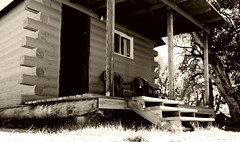
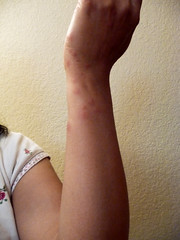
We almost called in the exterminators ourselves. You see, we had camped in the cutest log cabin in Mesa Verde, Colorado on our summer vacation and we loved it so much that we stayed an extra day. I was being bitten from the first night itself but I brushed it off as mosquito bites. It only got worse the next night by which time I was sure it was something in the wood. The third night was sheer torture. Next, we camped out in the open in the Sand Dunes and my bites worsened. Yes, we had carried them with us in our sleeping bags. Bed bugs bites are usually linear and in groups of three bites: breakfast, lunch and dinner.

168/366: Bitten

When we returned home, I had bites on my scalp, my face, my neck, my belly, my back, my arms and my legs. Everywhere. The itch was sheer torture. It is good to know that bed bugs are not carriers of any disease but if you scratch the bites and draw blood, the open wounds could get infected. Our body releases histamines in response to insect bites and there is often an allergic reaction to the bites that looks very much like a bite itself! It's a good idea to start on over-the-counter anti-histamines or get a prescription as soon as possible. Cold compress or ice wrapped in soft cotton is the best topical antidote. Mild steroidal hydrocortisone also helps reduce the itch but remember that I am not a doctor, so always seek advice from a professional in these matters.

I washed every single thing that could be washed, in very hot water. That which could not be washed was bundled up and loaded back into the van. Luckily for us, it was the dog days in Colorado. A heat wave and for once, I was really very happy about it. The van stood in the sun and if there were any bed bugs, they were cooked as temperatures inside the van soared to 110F-120F. Yes, cook them! And then vacuum, vacuum, vacuum your house and then do it all over again, especially the crevices, cracks and areas that could potentially serve as good hiding places.

Sleeping at night became a pipe dream, a thing of the past. We were not being bitten anymore but we started imagining that we were. Yes, serious mental anguish and paranoia ensued! We read that if you think you are being bitten, then it is best not to turn on the lights as the bed bugs will simply move back to their hiding places very quickly. Instead, keep a flashlight by your side and use that to look for them. We had flashing lights in our bedroom for many many sleepless nights.

So what does kill them? I guess there are commercial pesticides that can be used only after evacuating the home. There is one more thing that is said to work: diatomeceous earth (DE). It is finely ground shells that feels almost like talcum powder to us but has jagged edges for those monsters bugs. If the bugs walk across a sprinkling of DE, their outer waxy coating is sliced or cut in places, leading to dehydration and death over a period of 4-5 days. DE could take up to 10 days to work. But it is organic and does not contain pesticides.

We found DE at the local hardware store and nursery and sprinkled it liberally all over the house, including our mattresses. In the van, too. After a few more days of paranoia, we were able to finally get some rest at night again and focus on our work and lives during the day.

Bed bugs are the worst nightmare anyone could have. And you literally sleep through their bites. Some precautions you could take when you travel include:
- removing all bedding from the mattress and inspecting the mattress for dark tell-tale stains of their feces. You should look for molted skin, eggs, eggshells, dead bugs and live bugs, too. If you see anything like this, ask for another room immediately. The hotel industry is currently in denial and will strongly refute the existence of bugs on their property.
- do not place your bags on the beds. Instead use the luggage racks and move them away from the walls.
- do not keep your clothes on the beds. Put them up on hangers instead.
- keep your bags closed at all times so that bed bugs do not crawl into them and hitch a ride home.

Other precautions include:
- avoid picking up mattresses left on the curbside
- if you buy anything secondhand - even a desk - inspect it for tell-tale signs of bed bugs

I know most of you will be grossed out by this information and my story. If it makes you more aware of the problem, I think it is well worth the nausea that you might be experiencing just now.


Are you interested in contributing to The Daily Tiffin? Drop us an email: thedailytiffin@gmail.com. We look forward to hearing your ideas.

This Post was written by Manisha of Indian Food Rocks


Labeled as Gifted

Friday, February 29, 2008

Posted by Indian Food Rocks

Being an exception in a world that prizes sameness is never comfortable at first. - Linda Silverman, Ph.D.
Gifted, to describe talented children, was not a word I was familiar with until I came to the US. I was more used to brilliant, extremely intelligent, exceptional and of course, talented. It took me a while to understand that gifted was different from special. A child with disabilities is special. A child with talents is gifted. And, both need special attention.

What is gifted, anyway? According to the National Association for Gifted Children (NAGC), a gifted person is someone who shows, or has the potential for showing, an exceptional level of performance in one or more areas of expression. There are many more definitions, none clearer than the previous one.

Some define gifted as having an IQ of 130 or more. Others feel a child is gifted if they can perform at 2 or more grade levels above their age. The No Child Left Behind Act of 2002 has its own definition. No matter what the definition, the first step is always identifying that a child is gifted. Understanding the difference between a bright child and a gifted learner is also critical to forming misconceptions about one's child.

I was largely in the 'my child is bright' camp until recently. It was first brought to my attention that my child might be more than bright when she started reading at the tender age of 3. There were times when I thought she was dyslexic because was and saw appeared to be the same to her. She read from left to right and from right to left without any discrimination. Most kids belted out the alphabet song ABC. She belted out ZYX because ABC had been done to death. It was when she started writing messages in mirror image on our living room window so that it could be read properly from the outside, that I finally took note of the fact that we may have something going on here. Still, I was unwilling to get her tested privately as, by then, I had heard many negative things about being labeled as gifted. She showed signs of intelligence and I felt that that was all that needed fostering. I didn't think she was ahead of her grade because quite frankly, within the Indian context, she was not. She was average. But, we were not in India and the truth was that she was not learning much in school. To her, school was a place for social interaction, not learning.

The school district she was in did not have anything besides the ISAT for student assessment. Since she was off the charts on those assessments, her kindergarten school sent her to a reading specialist so that she could read instead of learn how to read. Her teachers were very enthused by her and looked forward to challenging her. As long as there was at least an attempt in that direction, I thought she would be fine. As time passed, it became clear that she needed more than what the local public schools could offer her. There were no private schools in the immediate area at that time. We decided to move to the Boulder area in Colorado because the public schools were known for being as good as, if not better, than focused private schools. Homeschooling was not an option even though it seemed like most of her learning occurred at home.

Boulder Valley School District has a Talented and Gifted Program (TAG) where children are tested using nationally accepted tests like the CogAT, Naglieri Non-verbal Ability test, Ravens tests, amongst others. It took nearly 2 years before my child was tested for the TAG Program, the primary issue being funding for testing. The No Child Left Behind Act was taking its effect and while 3rd grade and up took the CSAP, testing for TAG had been suspended. Change came in Spring 2007, when both houses of the Colorado General Assembly passed a bill that was then signed into a law by Gov. Bill Ritter in June, that made it mandatory for all state administrative units to adopt and implement a program plan to identify and serve gifted children. Thank you, Bill Ritter! My child was tested in October 2007, after first having been suggested as a potential candidate in March 2006. She is now labeled as gifted.

A lot of this may not be relevant to your particular situation but this is an indication of what you might face from the public school system in the US should you feel that your child's educational needs are not being met and that perhaps he or she is gifted. An alternative is private testing from centers like Linda Silverman's GDC.

We have had interesting run-ins with several parents who believe that their child does not get the attention he or she deserves as teachers' energies are focused on children on the extreme end of the spectrum: those who need help learning and those who need to be challenged. They don't say it to our faces but they believe that TAG programs are elitist because schools with gifted programs offer special treatment for "smart kids" that already have it going for them, especially in the classroom. Whereas I believe that every child has a right to education and that gifted education is more about meeting the academic needs of students whose abilities and knowledge exceed what is being taught in the regular classroom.


This is the first of a series of articles on giftedness. My next article will focus on why you should get your child tested for giftedness. Do share your thoughts and experiences as we could learn from your experiences. You see, this is a journey we embarked on several years ago - we just didn't know that we were traveling or where we were headed.


Are you interested in contributing to The Daily Tiffin? Drop us an email: blogmeeta@gmail.com. We look forward to hearing your ideas.

This Post was written by Manisha from Indian Food Rocks.

Gulkand

Tuesday, June 30, 2009

Posted by Indian Food Rocks

It's no secret that I am a lazy gardener. I prefer to let wildflowers and native grasses rule my yard than spend hours tending to specialty flowers and plants. The few plants that I have brought into my yard are drought-resistant. My neighbor cultivates roses. He has blossoms of various colors on the same bush. Me? I love the wild rose, Rosa woodsii.


It's a treat to see this wild rose in bloom as it lasts for just a day. If I could, I would have a thicket of wild roses to line my property but wilder things would leap over it, so I have abstained from taking it on. I do have a bush of hardy climbing roses that refuses to die. When it didn't bloom one year, I was rather thrilled because I had other plan(t)s for the coveted spot it is in, but it bounced back the following year and blooms profusely late spring through early summer.


If I hadn't been consumed by bed bug bites during late spring last year, I might have noticed my climbing rose bush. This year, I did take notice: the flowers are small but they do have a pleasant fragrance. That, to my mind, translates into essential oils even though this is no damask rose. I figured that these roses might have at least some of the 300 compounds reported to be found in rose oil.

While roses are generally not used in western cuisine, their culinary history can be traced back to Persia. Roses are used as flavoring agents in Middle Eastern as well as Indian cooking. Since I do not have the wherewithal to make rose water or extract rose oil, I decided to do the next best thing: make Gulkand in the sun, now that we have a respite from the incessant rains we have seen this spring. Gulkand is often referred to as rose petal jam but let's please just call it gulkand (Gul-kundh) - gul for rose and kand for sweet.

My first task was to deadhead the bush. Once I had that out of the way, I took stock of the number of buds on the bush to make sure that I would have enough petals to justify making gulkand. Just opened blooms are best for gulkand so it's worth the effort to wake up early to pluck the flowers off the bush.

Remove the petals gently, discarding petals that may be disfigured, have holes or appear to be eaten by insects. Also, discard the rest of the flower. Inspect closely to make sure there are no insects or other creatures that might inadvertently make it into your gulkand, making it not so vegetarian.

Wash the petals several times and lay them out on a wad of paper towels. There is no need to pat them dry as any residual water will simply aid in making the sugar syrup.


In an wide-mouthed jar, make layers of rose petals and sugar, pressing down with a spoon every so often and finishing off with a layer of sugar at the very top. Since my flowers were small, I arrived at the following estimate for a recipe:
3-4 cups of rose petals
3/4 to 1 cup of organic sugar
3 cloves (optional)
seeds of 1 cardamom (optional)

I like the hint of spices in my gulkand so I added cloves and cardamom. Allow this to cook in the sun for at least two weeks. Open it up every other day, not just to get a whiff of the heady fragrance, but to mix it up, too.


This little jar was overflowing when I put the lid on it. It whittled down to just about an inch thick in less than a day. I made two more jars of the same quantity and after a week of being in the sun, I combined them all into this same jar. It's been just over a week and I will update this post with a picture of gulkand as soon as it is ready. Until then, take a look at Anita's Gulkand.

If you have roses that have not been sprayed - please do not use store-bought roses unless you know they are organic and safe for consumption - do give this a try. It's great as a summer activity for kids, too. Which kid doesn't like ripping petals off flowers? They can also take the responsibility for putting the jar out in the sun and bringing it in every day.

Gulkand is supposed to have cooling properties and is best consumed in summer. And, supposedly a host of other benefits for the entire body. My parents sourced the purest and best gulkand for me to help cool my highly myopic eyes and perhaps even deter what genetics had in store for me. I can't say that it worked but I do know that unlike those awful Threptin biscuits that I launched off an 11th floor balcony or that terrible tasting Chyawanprash that followed a trajectory to the ledge under my bedroom window, gulkand made its way safely to my stomach with the spoon being licked clean each time!


This post was written by Manisha

Are you interested in contributing to The Daily Tiffin? Drop us an email: thedailytiffin@gmail.com. We look forward to hearing your ideas.

Testing for Giftedness

Tuesday, May 20, 2008

Posted by Indian Food Rocks

I work with children to whom things have come very easily. My job is to have them hit a wall and then show them how to scale it. - W. Buffer, Intervention Specialist, Boulder Valley School District, Colorado


In my last article, I shared my unwillingness to get my child tested for giftedness. Yet, once I realized that her needs were not being met in the classroom and that home-schooling was not an option for us, I found out as much as I could about being labeled as gifted and pushed for testing. I do feel the need to clarify that this series of articles is merely a reflection on our journey and to share some of the insights gained along the way with the hope that it might help someone else out there in similar circumstances. It is most definitely not to say that my child is better than anyone else's.

Every child astonishes its parents in one way or another as it grows. There is innate and latent talent in every child, waiting to come forth. In some children, it is apparent at a very young age and parents are left wondering whether they are meeting their child's needs adequately. In most cases, the child will lead the parent to research and provide appropriate input right from the early years. My recommendation is for parents to enjoy this phase and encourage learning through visual stimulation as well as physical exploration. Reading, simple puzzles, math games, movies - especially documentaries on nature and discovery - will ensure that learning is fun and support your child's creativity.


Once your child is in school, find out what your school district offers by way of after-school enrichment as well as programs for Gifted and Talented (G/T). If the school offers testing, opt for this as soon as possible. There are several reasons I recommend this.

  1. The first and foremost is that it opens up many doors. Within our school district, for example, there is a mailing list through which information about G/T activities all over the country is shared: events, articles, new findings, invitations to G/T centric seminars, and even invitations from the local universities for classes for special interest groups. I cannot even begin to estimate the amount of time I would have had to spend to come up with even 10% of the information I receive via this mailing list.
  2. Once on the G/T track, always on the G/T track – for as long as there is a program within the school district. In our school district, the program carries on through high school. Children tested in kindergarten are never tested again. It is up to the parents to decide whether or not the program is of any benefit to the child and take the necessary action. Testing is expensive for the schools and repeat tests even more so.
  3. Age plays a large factor in how the tests are graded. They are therefore more difficult in the higher grades than in the lower grades, making it easier for a child to be accepted into the G/T program earlier than later.
  4. Once tested and approved for the G/T program, your child will probably attend an intervention program where his skills are constantly challenged and he is placed in learning situations that are not generally found within the typical classroom: mixed grade instruction, for example. Topics of instruction may range from Greek Mythology to Banking and International Trade to Impressionist Art. There is nothing that a curious and open mind cannot absorb.
  5. I strongly recommend utilizing all the resources that your school may offer you and push for testing before your child reaches the age of 9 or 10. It has been noted over and over again that gifted children, especially girls, start suppressing their intellectual and lateral skills for social reasons. It is cool to be hip, wear make-up, low-rise jeans with revealing tees, and walk instead of play during recess. It is not cool to be intelligent. Girls are mean and become more ruthless in middle school.


Most of what I have written has been within the context of public schools in the US and based on my experience with two school districts in different states. If there is no specific G/T program within your school, you could evaluate moving to a school that has a relevant program. Before you take a step of this nature, it would be prudent to speak with your child's teacher to see if she can work with you to challenge your child more in the classroom. Teachers are usually thrilled to have a student like this in their class and many will step outside their comfort zone and make an effort.

Another option is to find a Yahoo Group or a Google Group for homeschooling in your area and subscribe to the daily digest. One such group that I subscribe to is the ILHS Announce Group on Yahoo. These are usually very active mailing lists that prove to be an amazing resource for everything from science projects to things to do in summer.


This is the second in a series of articles on giftedness. My next article will focus on board games that depend largely on strategy, rather than luck.


Are you interested in contributing to The Daily Tiffin? Drop us an email: blogmeeta@gmail.com. We look forward to hearing your ideas.

This Post was written by Manisha of Indian Food Rocks

A Taste of Slow Food

Friday, December 05, 2008

Posted by Meeta K. Wolff


Orange on white 01framed

It’s easy to eat poorly or inadequately in our fast food culture. Overworked and stressed we rush out to find a quick bite and often find solace in a burger or a hot dog. The temptation of sugar, salt and fat feel good while you are eating it but it really does little to satisfy you. It’s convenient at the time and stills your hunger. Dinner might be a quick microwave meal, frozen pizza ready in minutes in the oven or even take out. Looking at the long term effects, it will make you and your family fat, lazy and sick!

We know that! However, I am still surprised when I read articles or watch reports that show over two third of us are overweight and one third are obese. More disheartening is the fact that over one third of our children are overweight and the CDC says that of the children born in the year 2000 - 30 - 40% will become diabetic in their lifetime.
We’ve read these dismal statistics so often - over and over.

Often parents preach to their children about the value of food, but send them mixed signals when meals are eaten in front of the TV or computer or take out food is ordered every other night. In our fast paced life, time is of essence and convenience becomes the main issue. In America, one of every four meals is eaten at a fast food restaurant; one in four is eaten in a car and one in three in front of a TV or computer!

Consider what these children are learning about the value of food. We are teaching them that it is “easier” and “cheaper” to purchase this type of “food” than to prepare real foods at home.

In one article I was reading recently a mother had never prepared a home cooked meal for her 4 year daughter! I was appalled and it prompted me to write this article.

In their recent articles, Manisha talked about invisible expenses and Peter about home economics to help you manage your costs and finances better. While the immediate cost of fast food might seem low, there are other types of costs we might also want to consider.

What is the long term cost of CO2 emissions, pollution, obesity and diabetes that inevitably comes from eating processed foods?

Enter the Slow Food Philosophy.

“Slow Food” is more of a philosophy than a cuisine. I am not talking about cooking a dish in a crockpot all day, but rather how slow food is defined by how it's prepared, and how it should be enjoyed. It's also the name of an international movement, founded in Italy.

slow_food The Slow Food Movement arose in 1986 in Italy as a response to the negative impact of multinational food companies and is spreading around the world – slowly! Today the Slow Food Movement has branches over the five continents, in 130 countries, with about 80 000 people.

Slow Food protests against the standardization of taste, it protects cultural identity, which is connected to food and seeks to safeguard processing techniques inherited from tradition. It also involves valuing time to prepare, eat and build a community through food. Sometimes the movement has been criticized as having an upper class pursuit, however far from extravagant eating, slow food is about the celebration of the connections that food can make with sustainable production and local food traditions that are often lost in our economy.

The slow food concept is about good, clean and fair food. It’s about allowing fruits and vegetables to ripen on the vine before being harvested and making breads from scratch. Slow food is about locally grown ingredients, traditional cooking methods and the producers and chefs who follow the creed.

And all of us can do join in on this philosophy to celebrate this kind of good, healthy food.

Here are a few ideas:

Summer Berries 03 framed Buy locally: Shopping for produce is an action with a huge impact. I cannot stress this enough! You make the choice to spend money on foods that are grown and picked in your region by local farmers and brought to the market, instead of traveling great distances.  Point out the sources to your kids when you are at the grocery store or the farmer’s markets. Now that Soeren can read he makes sure that the produce that lands in our shopping basket is from our region. Sometimes he will frown at me if I place a mango from Brazil in the cart! ;-)

Go for Organic: Whenever you can. This reduces your family’s and your exposure to pesticides and chemical fertilizers. You will soon realize that several of the items simply taste better too. Several years ago when I made the decision to buy organic produce there were two things I always had in my mind. One was the fact a close friend of mine was diagnosed with a rare cancer type. Her doctor told her that the tests were showing high levels of certain chemicals found in pesticides, deducing that the cancer might have been a result of the food she was eating! I decided that this was not what I wanted for my child or my family. I paid the extra cent for organic produce happily. This brings me to the second point. The fact I am paying a little more for organic food – I take more care of what and how I am preparing food. I buy less and make sure we waste less. Today I would say we are eating 90% organically and regionally. Yes – I am proud of this fact.
Also read:
Organic Food - What is it?
Is Organic Food Healthier?

Tomatoes 02 framed Grow your own: If you have a garden, grow your own produce. If space is tight fill a few pots with herbs and tomatoes. The point here is you are not only picking and enjoying fresh food from your own backyard, you will also be giving your children priceless values about the concept of food.

Cook at home: Even if you're short on time, you can still enjoy delicious homemade meals that can be ready in 30 to 40 minutes. We’re not saying no to burgers but rather saying yes to healthy homemade burgers, where you control what goes into them. This is healthy fast food and you will find a plethora of great recipes to get you started on the Internet. A few you will find on iVillage 19 30-minute meals. You’ll also find several great lunch box ideas for healthy meals for you and your kids right here on the DT.

Get your kids involved. It’s part of the slow food picture – to spend valuable time with your family. Not only are you spending quality time together with your children in the kitchen, but you are teaching them how to be involved in the food choices that they make. By getting actively involved they are learning that they can make choices about the foods and ingredients that they consume. Be creative with the food you prepare and let your kids express themselves through their recipe choices and presentation.

Finally share food. Use food to help others who might not be able to provide or cook for themselves. From a simple doubling a recipe and taking a home-coked meal to someone who is ill or donating food to the food drive, are all aspects that will teach your children the value of food. Soeren and his school collect food every year in December for our local food drive here in Weimar.
Drop in & Decorate
This year I have organized with his class to host our very own Drop In and Decorate event, which is a charity event started by my dear friend and DT alumni writer Lydia (more on that later).

Become a part of the slow food manifesto. You do not have to join the movement but you can use the same principals to make changes in your food culture. It’s important we practice what we preach and set the right examples so our children grow up making the right food choices.

Interesting reads:

Slow Food Movement
Ministry of Food
Ecoglobe – The Slow Food Movement


Are you interested in contributing to The Daily Tiffin? Drop us an email: thedailytiffin@gmail.com. We look forward to hearing your ideas.

This post was written by Meeta

When a Beautiful Hike Can Go Wrong

Thursday, April 30, 2009

Posted by Indian Food Rocks

I wouldn't say we are avid hikers or adventurers but we do like to hike as a family. That usually limits us to easy to moderate hikes with moderate gains in altitude. The longest hike we have done is a 5.4 mile hike along The Loop in Rocky Mountain Park. We always take the necessary precautions:

  • we carry enough water for each person
  • we wear sunscreen
  • we carry or use insect repellent
  • we carry several layers of clothing, including one that is water resistant, as the weather can change in a heartbeat in the Rockies
  • we carry walkie-talkies just in case. Most of the time, my daughter uses these to sing to everyone else who might be on the same frequency.
  • we do not let our daughter walk alone ahead or behind us - we're usually in mountain lion territory.
  • we carry energy bars or fruit leather on short hikes. On slightly longer hikes, I carry boiled eggs - it's the only time I eat boiled egg yolk - and sandwiches.
  • the hikes we go on have well-marked trails so we don't need a map but we carry the one the Park gives us anyway.
  • we stay on the marked trail.
  • we don't pick wildflowers or mushrooms or any plants.
  • we're keyed into the weather and if we see a thunderstorm approaching - a very common afternoon phenomenon around here - we pack up and head for safety.
  • we do not hike in the dark, except at Delicate Arch in Arches National Park, where the hike back is well after sunset and partly in the dark.
  • we carry flashlights.
Is it possible then that anything could go wrong? It can and it did. On a very easy hike - you could even call it a stroll. You see, there were a couple of important things that are not covered in the list above and add to it a sense of complacency.

Like out of a dream, the kind that suddenly goes bad without any warning
We were hiking in Yosemite National Park over spring break late last month. The hike or stroll in question was around Mirror Lake, a shallow pool of water along Tenaya Creek that has fabulous reflections during spring. As the season progresses, the water dries up to reveal sandy beach-like areas along the creek. People walk off the trail and onto these beaches for a picnic.

YO-12

I was so enamored by the reflections that I started to lag behind as we walked towards the beach. Usually, we are always within earshot and sight of one another and no matter what, my daughter is never alone. Soon, my family had gone so far ahead that I couldn't see them. When I reached what looked like the access point to the sandy area, I looked out and couldn't see them. I saw other picnickers frolicking away instead. Irritated, I continued along the trail thinking that it was rather typical of my significant other to keep going. He is known for pushing us further and further on every hike. Hmmph. He might have waited for me to catch up!

As I hiked on alone, the forest started getting thicker and there was no-one ahead of me or behind me. I looked in my backpack and oops! I'd forgotten the walkie-talkie in the car. There was no way I could ping them and my cellphone was also in the car - not that it would have helped any as T-Mobile has no reception, whatsoever, in the Park. AT&T does have a signal in some parts of the Yosemite Valley. After about 20 minutes, the terrain started becoming rockier and I decided to turn back. A short while later, I met a couple who were planning to hike to the head of the creek and they promised me that they would let my family know that I had turned back, if they ran into them. The couple then advised me to stay put at the trailhead, which was 1.2 miles from the parking lot, because my family would have to go past the trailhead to get back to the car.

I returned and waited at the trailhead. And waited and waited and waited. It was nearing sunset and becoming progressively colder. After an hour of fuming, I decided to give them another half hour before going in search of a ranger. Luckily, I didn't have to because two very worried and very angry persons showed up soon thereafter.

They had not walked on ahead along the creek like I had assumed. Instead, they were trying to get back onto the trail from the sandy beach and could not be seen from the trail. When they got back onto the trail, they assumed that I was still walking towards them and so walked back. When they didn't find me along the trail, they walked back to the car. [3.4 miles total at this point] They had tried calling me on the walkie-talkie and got no answer and realized why when they saw the walkie-talkie in the car. That was my first Oops! Since it was an easy hike, I was not careful about ensuring that I had my walkie-talkie with me.

They found the second set of car keys also in the car. That was my second Oops! Always keep a second set of car keys with another person in the group so that if you split up, the other group has access to the car, especially if you traveled in one car. Of course, if both keys end up with the group that gets lost, not much can be done!

Since they now knew why they could not contact me, their irritation levels were higher than their concern levels. They walked back to the trailhead [4.6 miles total at this point] and found me. This was my third Oops! If you get separated from your group, head back to where you left the car or always have a place that you will meet at and, also agree upon the latest time that everyone should expect to reconvene in such an event. We never expected to lose each other and while it seemed practical to me to wait at the trailhead, it wasn't for several reasons. The trailhead was a short loop and returning hikers usually take the shorter route out to road that leads to the parking lot. Not that it mattered, in this case, because when I reached the trailhead, they had already gone past it on their way to the parking lot! Also, I would have been exposed to the elements at the trailhead had there been a storm. Another point to consider: discuss how long each party should wait before going in search of help.

After taking turns to vent, we walked back to the car together and when we reached the parking lot, two out of three of us had walked 5.8 miles of which 2.4 miles was completely unnecessary and could have been avoided easily.

So learn a lesson from our experience where I made several basic mistakes on a very easy hike, despite having hiked for so many years.


This post was written by Manisha

Are you interested in contributing to The Daily Tiffin? Drop us an email: thedailytiffin@gmail.com. We look forward to hearing your ideas.